What should a trucking invoice include?
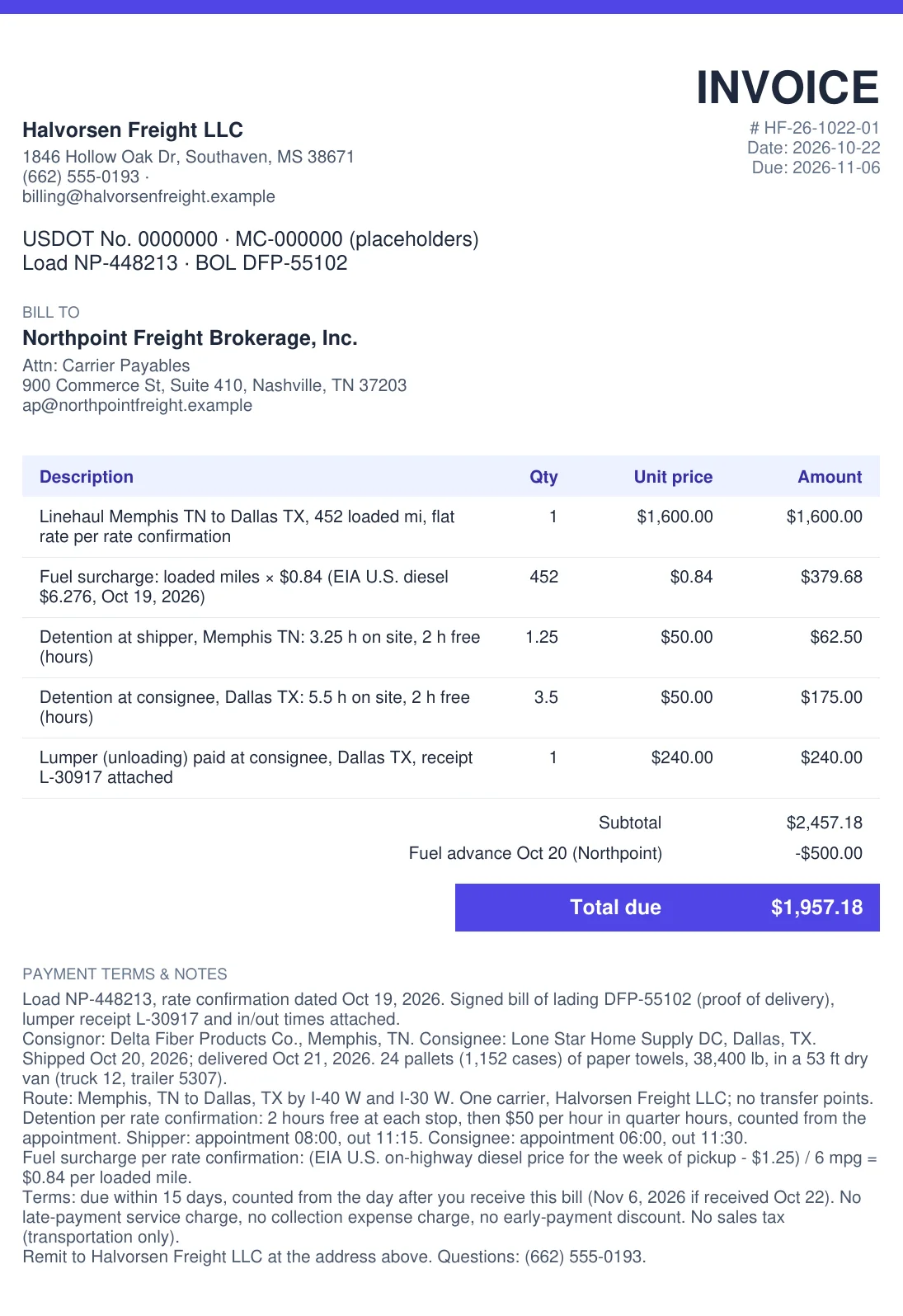
The shipment details and every charge with its rate. 49 CFR §373.103(a) says "Every for-hire, non-exempt motor carrier of property shall issue a freight or expense bill for each shipment transported" and lists what goes on it: consignor and consignee, date of shipment, origin and destination, number of packages, description of freight, weight, "Exact rate(s) assessed.", "Total charges due, including the nature and amount of any charges for special service and the points at which such service was rendered.", the route and each carrier, transfer points, and "Address where remittance must be made or address of bill issuer's principal place of business." Add your legal name, USDOT and MC numbers, the load or rate confirmation number, the bill of lading number, the payment terms, and attach the signed bill of lading and any receipts. The example: $2,457.18 in charges, a $500.00 fuel advance taken off, $1,957.18 due.
Line items truckers actually bill
- Linehaul: a flat rate for the load, or loaded miles × rate per mile. Name origin and destination and the load number.
- Fuel surcharge as its own line with the diesel price, its date and the miles, if your rate confirmation pays it separately rather than all-in.
- Detention, one line per stop: hours on site, free time, rate. The in and out times go in the notes.
- Lumper or other unloading fees you paid, at cost, with the receipt number.
- Other accessorials your rate confirmation allows: extra stops, layover, driver assist, truck ordered not used. Say where each happened.
- Advances the broker already paid, subtracted at the end, so the total due is what is left.
How the example adds up
| Part of the invoice | Working | Amount |
|---|---|---|
| Linehaul | Flat rate, Memphis to Dallas, 452 loaded miles | $1,600.00 |
| Fuel surcharge rate | ($6.276 − $1.25) ÷ 6 mpg = $0.8377, rounded to $0.84 per mile | |
| Fuel surcharge | 452 loaded miles × $0.84 | $379.68 |
| Detention, shipper | 08:00 to 11:15 = 3.25 h − 2 h free = 1.25 h × $50 | $62.50 |
| Detention, consignee | 06:00 to 11:30 = 5.5 h − 2 h free = 3.5 h × $50 | $175.00 |
| Lumper | Paid at the Dallas dock, receipt L-30917 | $240.00 |
| Subtotal | All charges | $2,457.18 |
| Fuel advance | Paid by the broker at pickup, Oct 20 | −$500.00 |
| Total due | $2,457.18 − $500.00, within 15 days of receipt | $1,957.18 |
The diesel price is real: the EIA's U.S. on-highway diesel average for October 19, 2026, released October 20 (EIA, Gasoline and Diesel Fuel Update). The linehaul rate, the fuel formula, the detention terms and the lumper amount are the example's, not a benchmark, and the company names, USDOT and MC numbers are placeholders.
In InvoiceSnap. The fuel advance goes in the Discount field (Fixed, relabelled with the date and who paid it), Tax % stays at 0 because a carrier that only hauls has no Texas sales tax to collect, and the load and bill of lading numbers sit in the License field so they print under your name.
What federal rules put on a freight bill
The list. 49 CFR §373.103(a)(1): "Every for-hire, non-exempt motor carrier of property shall issue a freight or expense bill for each shipment transported containing the following information:" names of consignor and consignee, date of shipment, origin and destination points, number of packages, description of freight, weight, volume or measurement (if it affects the rate), "Exact rate(s) assessed.", "Total charges due, including the nature and amount of any charges for special service and the points at which such service was rendered.", "Route of movement and name of each carrier participating in the transportation.", "Transfer point(s) through which shipment moved." and "Address where remittance must be made or address of bill issuer's principal place of business." The example's notes cover each item; detention and the lumper say where they happened because they are special services.
Who gets it. "The shipper or receiver owing the charges shall be given the freight or expense bill and the carrier shall keep a copy as prescribed at 49 CFR part 379." (§373.103(a)(2).) The bill of lading is a separate document with a shorter list (§373.101); send a signed copy with the invoice as proof of delivery.
When to send it, and when it is due
Send within 7 working days. On collect shipments the freight bill goes out within 7 days of delivery, and "This time period does not include Saturdays, Sundays, or legal holidays." On prepaid shipments the 7 days run from when the carrier received the shipment (49 CFR §377.205(a) and (b)).
Due in 15 days unless a tariff says otherwise. §377.203(b) and (c): "The credit period shall begin on the day following presentation of the freight bill." and "Unless a different credit period has been established by tariff publication pursuant to paragraph (d) of this section, the credit period is 15 days. It includes Saturdays, Sundays, and legal holidays." A tariff can change it, up to a cap: "Such credit periods shall not be longer than 30 calendar days." Early-payment discounts are allowed by tariff rule (§377.203(f)). The example's bill, received October 22, is due November 6.
State the terms on the bill. "Bills or accompanying written notices shall state penalties for late payment, credit time limits and service charge and/or collection expense charge and discount terms." When you have late-payment penalties, the bill or notice must say "failure timely to pay freight charges may be subject to tariff penalties" or something similar (§377.205(c)). The example has no penalties, so its terms say so in plain words.
Detention, lumpers and fuel
Lumpers. When a shipper or receiver wants the truck loaded or unloaded with help, "the shipper or receiver shall be responsible for providing such assistance or shall compensate the owner or operator for all costs associated with securing and compensating the person or persons providing such assistance." (49 U.S.C. §14103(a).) That is the basis for billing the example's $240.00 lumper back at cost, with the receipt.
Detention. Neither Part 377 nor §14103 mentions detention (we searched both), so the rate and free time come from your rate confirmation. A 2015 law told the Department of Transportation to "establish by regulation a process to collect data on delays experienced by operators of commercial motor vehicles before the loading and unloading of such vehicles and at other points in the pick-up and delivery process." (statutory note to §14103.) We did not check what has come of that. Log appointment, arrival and release times on the bill of lading or in your ELD notes; the example puts them in the invoice notes.
Fuel. The EIA publishes weekly average prices in its "Gasoline and Diesel Fuel Update", including a table of "U.S. On-Highway Diesel Fuel Prices" by region. The example uses the U.S. figure for the week of pickup, $6.276 a gallon. Use whichever price and region your rate confirmation names.
Where the rules don't line up
Written for shippers and tariffs, used with brokers and contracts. §373.103 and Part 377 talk about the shipper or receiver who owes the charges and about credit terms set by tariff. On a brokered load like the example, the broker pays the carrier under a rate confirmation, and neither §373.103 nor Part 377 mentions brokers (we searched both). Contracts can also sign rights away: "If the shipper and carrier, in writing, expressly waive any or all rights and remedies under this part for the transportation covered by the contract, the transportation provided under the contract shall not be subject to the waived rights and remedies" (49 U.S.C. §14101(b)(1)), though "The parties may not waive the provisions governing registration, insurance, or safety fitness." So the example follows the federal freight-bill list and the 15-day default because they are easy to meet, and its terms match a 15-day rate confirmation. If your rate confirmation says 30 days or quick pay, that contract is what the broker will pay by; whether it overrides Part 377 for your load is a legal question we did not check.
Texas: is freight taxable?
A carrier that only hauls: no tax to collect. "A third party carrier (separate legal entity) will not be responsible for collecting or remitting tax as long as the third party carrier only provides transportation and does not sell the taxable item being delivered." (34 TAC §3.303(b), read on the Secretary of State's TAC viewer.) That is why the Dallas delivery in the example has no tax line.
A seller that delivers: taxable. "The charges for transportation or delivery, both before and after the sale, are taxable even if stated separately from the sales price of a taxable item." (§3.303(a).) If you sell the goods and also deliver them, the delivery charge follows the item.
What we did not check
- Freight sales tax in any state other than Texas.
- Rules for hauling within one state, including state authority, intrastate rates or invoice requirements.
- Whether a particular rate confirmation or broker-carrier agreement waives Part 377, and how state contract law treats late payment by brokers.
- Factoring: notices of assignment, who the broker must pay once an invoice is factored, and factoring fees.
- Typical linehaul, detention, lumper or fuel surcharge rates; the example's are made up for the arithmetic, except the EIA diesel price.
- IFTA fuel tax, the Heavy Vehicle Use Tax and 1099 reporting by brokers.
This is a summary of 49 CFR Parts 371, 373 and 377 (eCFR, current as of October 22, 2026), 49 U.S.C. §§14101 and 14103 (U.S. Code, 2024 edition, on govinfo), 34 TAC §3.303 and the EIA's weekly diesel prices as read on October 24, 2026, not legal or tax advice. Check with the FMCSA, the Texas Comptroller, or your attorney or accountant.
FAQ
How do I make a trucking invoice?
Start from the rate confirmation and the signed bill of lading. Put the linehaul on the first line (flat rate with Qty 1, or loaded miles in Qty and the rate per mile in Unit price), then one line per accessorial the rate confirmation allows: fuel surcharge, detention at each stop, lumper, extra stops, layover. Say where each one happened. Enter any advance the broker already paid you in the Discount field, set it to Fixed and relabel it. Put the load and bill of lading numbers in the License field and the shipment details and terms in the notes. In InvoiceSnap the totals update as you type and the free preview PDF shows the finished invoice.
What is the difference between a freight bill, a bill of lading and an invoice?
The bill of lading is the receipt for the freight: "Every motor carrier subject to § 373.100 shall issue a receipt or bill of lading for property tendered for transportation in interstate or foreign commerce" (49 CFR §373.101), with the consignor and consignee, origin and destination, number of packages, description and weight. The freight bill (the regulation also calls it an expense bill) is the bill for the charges: the same shipment details plus the exact rates, the total charges, the route and the remittance address (§373.103). A trucking invoice that carries all of that, like the example, is the freight bill. Send it with a copy of the signed bill of lading as proof of delivery.
How do I bill detention on a trucking invoice?
As its own line for each stop, with the hours on site, the free time and the rate, and the in and out times in the notes. The amount comes from your rate confirmation or contract, not from a federal rule: Part 377 (payment of transportation charges) and 49 U.S.C. §14103 don't mention detention (we searched both). The example's rate confirmation gives 2 free hours per stop, then $50 an hour in quarter hours: 3.25 h at the shipper bills 1.25 h ($62.50) and 5.5 h at the consignee bills 3.5 h ($175.00).
How do I bill a lumper fee?
As a reimbursement line with the receipt number, and attach the receipt. Federal law puts unloading help on the shipper or receiver: "the shipper or receiver shall be responsible for providing such assistance or shall compensate the owner or operator for all costs associated with securing and compensating the person or persons providing such assistance." (49 U.S.C. §14103(a).) It also makes it unlawful to coerce a carrier "to load or unload any part of such property onto or from such vehicle or to employ or pay one or more persons to load or unload any part of such property" (§14103(b)). The example's driver paid $240.00 at the Dallas dock and bills it back at cost.
How is a trucking fuel surcharge calculated?
By whatever formula your rate confirmation or contract sets; no federal rule we read sets one. The example's formula starts from the weekly U.S. on-highway diesel price that the EIA publishes on its "Gasoline and Diesel Fuel Update" page. It is (EIA price − $1.25) ÷ 6 mpg per loaded mile: ($6.276 − $1.25) ÷ 6 = $0.8377, rounded to $0.84, × 452 loaded miles = $379.68. The $1.25 base and 6 mpg are the example's terms, not a standard. Put the price, its date and the miles on the line so the broker can check it.
When do I have to send a trucking invoice?
Within 7 working days. For collect shipments, 49 CFR §377.205(b)(2): "The time period for a carrier to present its freight bill for all transportation charges shall be 7 days, measured from the date the shipment was delivered at its destination. This time period does not include Saturdays, Sundays, or legal holidays." Prepaid shipments run 7 days from when the carrier received the shipment. If you can't work out the charges yet, the 7 days start when you have the information (§377.205(d)(1)). The example was delivered Wednesday, Oct 21 and invoiced Thursday, Oct 22.
What payment terms can a trucking company put on an invoice?
Under 49 CFR §377.203, "The credit period shall begin on the day following presentation of the freight bill." and "Unless a different credit period has been established by tariff publication pursuant to paragraph (d) of this section, the credit period is 15 days. It includes Saturdays, Sundays, and legal holidays." A tariff can set a different period, but "Such credit periods shall not be longer than 30 calendar days." The invoice or a notice with it must state the payment deadline and any late-payment, service charge, collection charge and discount terms (§377.205(c)). The example says 15 days and that it has none of those charges. Haul for a broker under a contract? See "Where the rules don't line up" above.
Do the federal credit rules apply when I haul for a broker?
Maybe not, and we did not check your case. Part 377's credit rules are written around tariffs and the person who owes the charges. A rate confirmation or broker-carrier agreement is a contract, and 49 U.S.C. §14101(b)(1) lets a carrier and shipper sign away rights: "If the shipper and carrier, in writing, expressly waive any or all rights and remedies under this part for the transportation covered by the contract, the transportation provided under the contract shall not be subject to the waived rights and remedies". Read your broker-carrier agreement and rate confirmation for payment terms and any waiver; whether a particular waiver reaches the Part 377 credit periods is a question for a transportation attorney.
Can I email a trucking invoice?
Yes, if the payer agrees. 49 CFR §373.103(a)(2): "If the bill is electronically transmitted (when agreed to by the carrier and payor), a receipted copy shall be given to the payor upon payment." For bills sent by mail, "the time of mailing shall be deemed to be the time of presentation of the bills" (§377.207(a)). If you send the invoice, signed bill of lading and receipts by email or a broker's upload portal, keep the sent date, because the credit period starts the day after presentation.
Can I bill a missed charge after the broker has paid?
Yes, on a separate freight bill for the additional charges. 49 CFR §377.209: when a carrier has collected the charges on a freight bill and "Thereafter presents to the shipper another freight bill for additional charges" it "may extend credit in the amount of such additional charges for a period of 30 calendar days from the date of the presentation of the freight bill for the additional charges." Check your rate confirmation first for any deadline on submitting accessorials.
Can a carrier see what the broker was paid?
The rule gives you a right to the broker's record. A broker must keep a record of each transaction showing, among other things, "The amount of compensation received by the broker for the brokerage service performed and the name of the payer" and "The amount of any freight charges collected by the broker and the date of payment to the carrier." and "Each party to a brokered transaction has the right to review the record of the transaction required to be kept by these rules." (49 CFR §371.3, as of October 22, 2026.) Ask in writing and cite the section.
Is freight taxable in Texas?
Not when a carrier only hauls. 34 TAC §3.303(b): "A third party carrier (separate legal entity) will not be responsible for collecting or remitting tax as long as the third party carrier only provides transportation and does not sell the taxable item being delivered." It is different when a seller delivers what it sold: "The sales tax applies to all transportation or delivery charges to a customer when a taxable item is sold, leased or rented on or after October 1, 1987, and delivery charges are billed by the seller or lessor to the purchaser or lessee." (§3.303(a).) So the example has no tax line. We did not check California, Florida, Colorado, New York, North Carolina, Illinois, Ohio or Alabama, which people also search for.
What is a TONU fee and how do I invoice it?
TONU means truck ordered, not used: a charge when a load is cancelled after you were dispatched. No federal rule we read sets one; Part 377 doesn't mention it. Bill it only if your rate confirmation or contract provides for it, as one line with the load number, the cancellation time and the agreed amount, and keep the cancellation message.
Does this work for hot shot, box truck or dump truck invoices?
Yes, the layout is the same: a linehaul line, then one line per extra charge, and the shipment details in the notes. If you bill dump truck work by the load, the ton or the hour, put the count in Qty and the rate in Unit price, and list the ticket numbers in the notes. The federal freight-bill rules quoted here cover for-hire carriers subject to FMCSA jurisdiction (interstate); hauling within one state follows that state's rules, which we did not check for this page.
Is InvoiceSnap free?
Yes. You can fill in the invoice and download a watermarked preview PDF free with no signup. A clean PDF is $4 one-time for 7 days of unlimited invoices (USDC; card coming soon).
Is my data uploaded?
No. The PDF is generated in your browser; your client and pricing details are not sent to a server.
More invoice templates
Freelance invoice template (fill online → PDF) · Independent contractor invoice template · Hourly invoice template (hours worked) · Consulting invoice template · Invoice with a discount line · Invoice template for international clients · Photography invoice template · Cleaning invoice template · Landscaping & lawn care invoice template · Plumbing invoice template · Electrician invoice template · HVAC invoice template · Roofing invoice template · Painting invoice template · Handyman invoice template · Deposit invoice template · Videographer invoice template · DJ invoice template · Tutoring invoice template · Lawn care invoice template · Late fee invoice template · Auto repair invoice template · Catering invoice template · Moving invoice template · Web design invoice template · Translation invoice template · Pest control invoice template · Graphic design invoice template · Snow removal invoice template · Pool service invoice template · Pressure washing invoice template · Window cleaning invoice template · Junk removal invoice template · Carpet cleaning invoice template · Dog grooming invoice template · Pet sitting invoice template · InvoiceSnap home