What should a videographer invoice include?
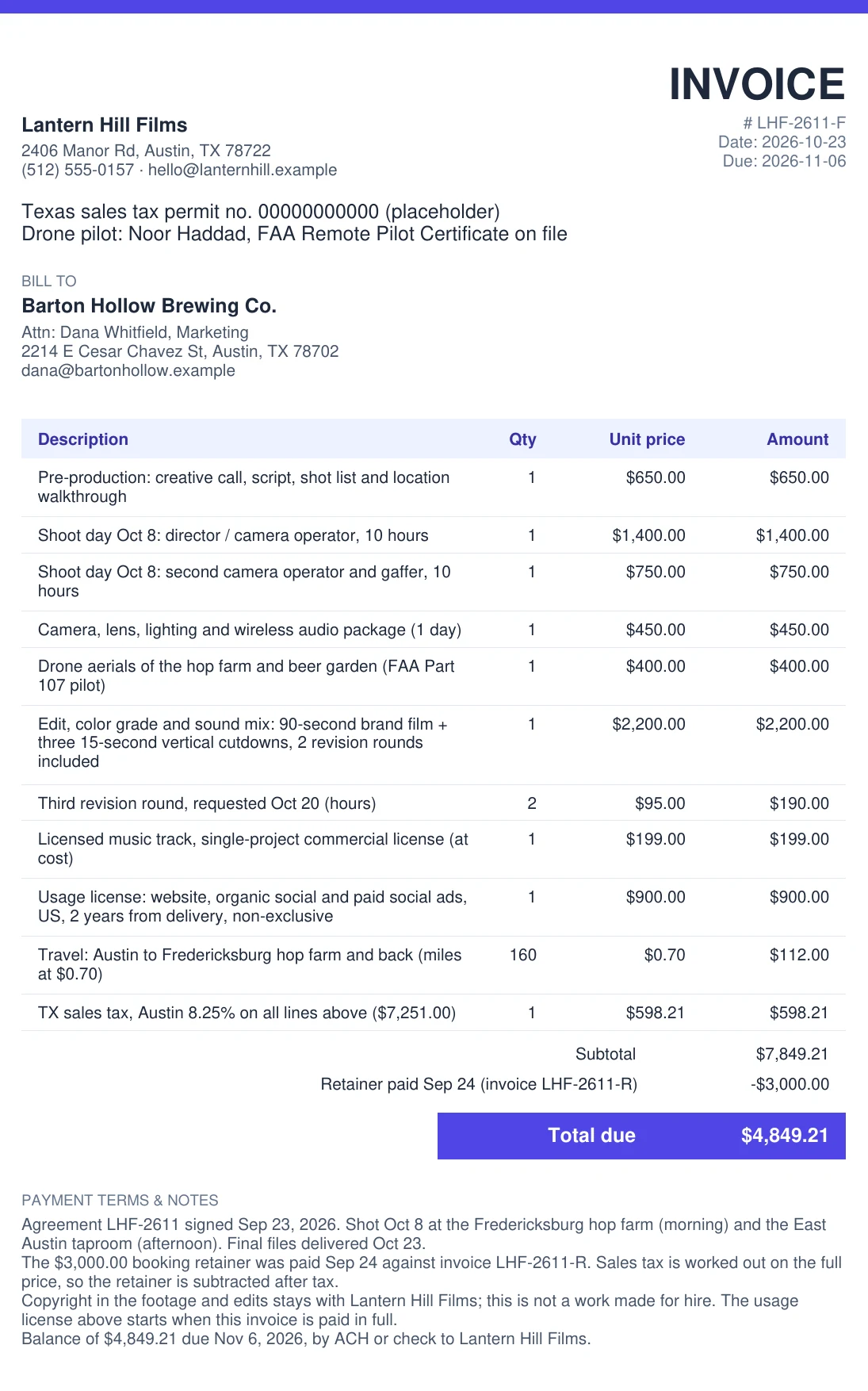
Your business name and contact details, the client's name, a unique invoice number, the shoot date and location, and the work split the way it was quoted: pre-production, each crew member's day rate, the gear package, any drone or specialty work, editing with the number of revision rounds included, extra revisions, licensed music, the usage license, and travel. Then the subtotal, sales tax where it applies, any retainer already paid, and the balance due. The example above does all of that for an Austin brand film: $7,251.00 of work, $598.21 Texas sales tax, $3,000 retainer subtracted, $4,849.21 due.
Line items videographers actually bill
- Pre-production: creative call, script, shot list, location scout. Bill it even when it is short, so it shows up when a client asks for a cheaper quote.
- Crew by the day, one line per person, with the hours in the description: director or camera operator, second camera, gaffer, sound recordist.
- The gear package on its own line (camera, lenses, lights, wireless audio), so a client who asks for a smaller crew can see what the kit costs separately.
- Drone work, with the certified pilot named.
- Post-production with the deliverables named: running time, aspect ratios, cutdowns, and how many revision rounds are included.
- Extra revisions, dated, by the hour.
- Licensed music and stock footage, at cost or with your markup stated.
- The usage license: media (web, social, paid ads, broadcast), term, territory, exclusivity.
- Travel: mileage with the rate, or flights and lodging at cost.
How the example adds up
| Bucket | Lines | Amount |
|---|---|---|
| Pre-production | Creative call, script, shot list, walkthrough | $650.00 |
| Production | Director/camera $1,400 + second camera/gaffer $750 + gear $450 + drone $400 | $3,000.00 |
| Post | Edit, color, mix $2,200 + third revision round 2 h × $95 = $190 + music $199 | $2,589.00 |
| Rights | Usage license, 2 years, US, non-exclusive | $900.00 |
| Travel | 160 miles × $0.70 | $112.00 |
| Sales tax | 8.25% of $7,251.00 | $598.21 |
| Retainer | Paid Sep 24 | −$3,000.00 |
| Balance due | Nov 6, 2026 | $4,849.21 |
Who owns the footage: the usage license line
The default. The US Copyright Office: "Ordinarily, the author is the person or persons who actually created the work you intend to register." A work made for hire is the exception, and for a freelancer it takes paperwork. A commissioned work counts only if it falls into one of nine categories, one of which is "as a part of a motion picture or other audiovisual work", and only "if the parties expressly agree in a written instrument signed by them that the work shall be considered a work made for hire." The Office adds: "If a work fails to satisfy any of these requirements, it is not a work made for hire." (Copyright Office Circular 30, Works Made for Hire, revised 08/2024.) Work your employees make as part of their job is different: that is made for hire automatically.
Selling the copyright outright. If the client wants to own the video rather than license it, that is a transfer, and "A transfer of copyright ownership, other than by operation of law, is not valid unless an instrument of conveyance, or a note or memorandum of the transfer, is in writing and signed by the owner of the rights conveyed" (17 U.S.C. §204(a)). An invoice line that says "full rights" is not that document, so put the transfer in the contract and price it on the invoice.
On the invoice. The example keeps the copyright and sells a license: web, organic social and paid social, US, two years, non-exclusive, $900, starting when the invoice is paid. A separate line makes a renewal or a broadcast add-on easy to quote later, without re-pricing the shoot.
Texas: sales tax on video production
Videography is taxable. Under the heading "Taxable Labor – Photographers, Draftsmen, Artists, Tailors, Etc.", the Comptroller explains that "tax is due on charges for manufacturing, assembling, fabricating or processing products, even when the customer provides the raw materials, tools or equipment," and the first example on its list is "photography and videography" (Publication 96-259, Taxable Services, 01/2026).
On every line. The taxable amount is the total, "without a deduction for the cost of" the "materials used, labor or service employed, interest, losses, or other expenses" (Texas Tax Code §151.007(a)). So the example taxes the crew, gear, drone, edit, revision round, music, license and travel together. A download counts the same as a disc: "the sale or use of a taxable item in electronic form instead of on physical media does not alter the item's tax status" (§151.010).
The rate. Texas state tax is 6.25% and local jurisdictions can add up to 2%, "for a maximum combined rate of 8.25 percent" (Texas Sales and Use Tax). Austin (Travis County) is at that 8.25%: 1% city plus 1% Austin MTA (Comptroller city rate table). 8.25% of $7,251.00 is $598.2075, which rounds to $598.21.
Why the tax is a line, not Tax %. InvoiceSnap takes the Discount off before it applies Tax %. Here the retainer is a payment, not a price cut, so the tax goes on its own line computed on the full $7,251.00 and the retainer comes off after it. Other states treat video production differently; check yours before copying the tax line.
Drone footage
The FAA: "If you have a small drone that is less than 55 pounds, you can fly for work or business by following the Part 107 guidelines." That means passing the knowledge test for a Remote Pilot Certificate and registering the drone; "Registration costs $5 and is valid for 3 years." (FAA, Certificated Remote Pilots including Commercial Operators.) Naming the pilot on the invoice, as the example does, answers the question before the client asks it.
This is a summary of US Copyright Office guidance, Title 17, the Texas Tax Code, Texas Comptroller publications and FAA guidance as of October 2026, not legal or tax advice. Check your contract and your state's rules with a lawyer or accountant.
FAQ
How do I break down a video production invoice?
Use the same four buckets as the quote. Pre-production (creative call, script, shot list, scouting). Production, billed per person per day with the hours in the description, plus the gear package as its own line. Post-production (edit, color, sound mix, motion graphics), with the deliverables named: "90-second brand film + three 15-second vertical cutdowns". Then the extras: revisions beyond what was included, music and stock licenses, the usage license, travel and any rentals. The client can match each line to the quote, and a change, such as the third revision round in the example, stands out on its own line.
How do I bill extra revision rounds?
Say in the quote and on the edit line how many rounds are included (the example says "2 revision rounds included"). When the client asks for more, bill it as its own line with the date it was requested and the hours, for example "Third revision round, requested Oct 20", Qty 2 at $95. Don't fold it into the edit price: a separate line shows the client why the total moved from the quote.
Who owns the video, and how do I invoice the usage license?
You do, unless you sign it away. The US Copyright Office: "Ordinarily, the author is the person or persons who actually created the work you intend to register." Commissioned video can be a work made for hire, because "a part of a motion picture or other audiovisual work" is one of the nine eligible categories, but only if the parties "expressly agree in a written instrument signed by them that the work shall be considered a work made for hire" (Circular 30). Without that signed agreement, you keep the copyright and the client gets the license you sell. Put the license on its own line and spell out where the video can be used, for how long, in which territory and whether it is exclusive, as the example does.
Is video production taxable in Texas?
Yes. The Texas Comptroller's list of labor that results in the sale of a taxable item starts with "photography and videography" (Publication 96-259, Taxable Services, 01/2026). The tax is on the total amount, "without a deduction for the cost of" the "materials used, labor or service employed, interest, losses, or other expenses" (Texas Tax Code §151.007(a)), and delivering the video as a download doesn't change that: "the sale or use of a taxable item in electronic form instead of on physical media does not alter the item's tax status" (§151.010). The example charges Austin's 8.25% (6.25% state plus 1% city and 1% Austin MTA) on every line, travel and the music track included.
Is video editing taxable in Texas?
The Comptroller's publication doesn't name editing on its own. Its general rule for this kind of labor is that "tax is due on charges for manufacturing, assembling, fabricating or processing products, even when the customer provides the raw materials, tools or equipment" (Publication 96-259). If you only edit footage your client shot and you aren't sure where you fall, ask the Comptroller before you decide not to collect tax. In the example the edit is part of a production the videographer shot, so it is taxed with everything else.
How do I show a retainer on an invoice with sales tax?
InvoiceSnap subtracts the Discount line before it applies Tax %, which would leave the retainer untaxed. When tax is due on the full price, do what the example does: set Tax % to 0, add the tax as its own line computed on the full subtotal ("TX sales tax, Austin 8.25% on all lines above ($7,251.00)", $598.21), then put the retainer in the Discount field as a fixed amount and rename it "Retainer paid Sep 24". The total is $7,251.00 + $598.21 − $3,000.00 = $4,849.21.
Do I need a license to bill a client for drone footage?
In the US you need to fly under the FAA's Part 107 rules. The FAA says "If you have a small drone that is less than 55 pounds, you can fly for work or business by following the Part 107 guidelines", which means passing the knowledge test to get a Remote Pilot Certificate and registering the drone ("Registration costs $5 and is valid for 3 years."). Put the drone work on its own line and name the certified pilot, as the example does in the license field.
How is a wedding videography invoice different?
It is usually one package line ("Wedding film: 8 hours coverage, 2 shooters, 5-minute highlight film, full ceremony edit") plus add-ons such as a rehearsal dinner, drone or a second-day shoot, with the retainer paid at booking subtracted and the balance due a set number of days before the wedding. Weddings rarely carry a usage license line, but the copyright point is the same: unless a signed agreement says otherwise, you own the footage. In Texas the Comptroller's taxable list names videography without separating weddings from commercial work.
How should a freelance video editor invoice?
Bill the edit by the hour or by the deliverable. By the hour, put the hours in Qty and the rate in Unit price, with the project and dates in the description ("Edit: episode 4, Oct 12-16 (hours)"). By the deliverable, name it and its length ("60-second product spot, 2 revision rounds"). Add stock footage, music or plug-in costs you passed through on separate lines, and say in the notes which files you will deliver: the finished export only, or the project files too.
Is InvoiceSnap free?
Yes. You can fill in the invoice and download a watermarked preview PDF free with no signup. A clean PDF is $4 one-time for 7 days of unlimited invoices (USDC; card coming soon).
Is my data uploaded?
No. The PDF is generated in your browser; your client and pricing details are not sent to a server.
More invoice templates
Freelance invoice template (fill online → PDF) · Independent contractor invoice template · Hourly invoice template (hours worked) · Consulting invoice template · Invoice with a discount line · Invoice template for international clients · Photography invoice template · Cleaning invoice template · Landscaping & lawn care invoice template · Plumbing invoice template · Electrician invoice template · HVAC invoice template · Roofing invoice template · Painting invoice template · Handyman invoice template · Deposit invoice template · InvoiceSnap home