What should a handyman invoice include?
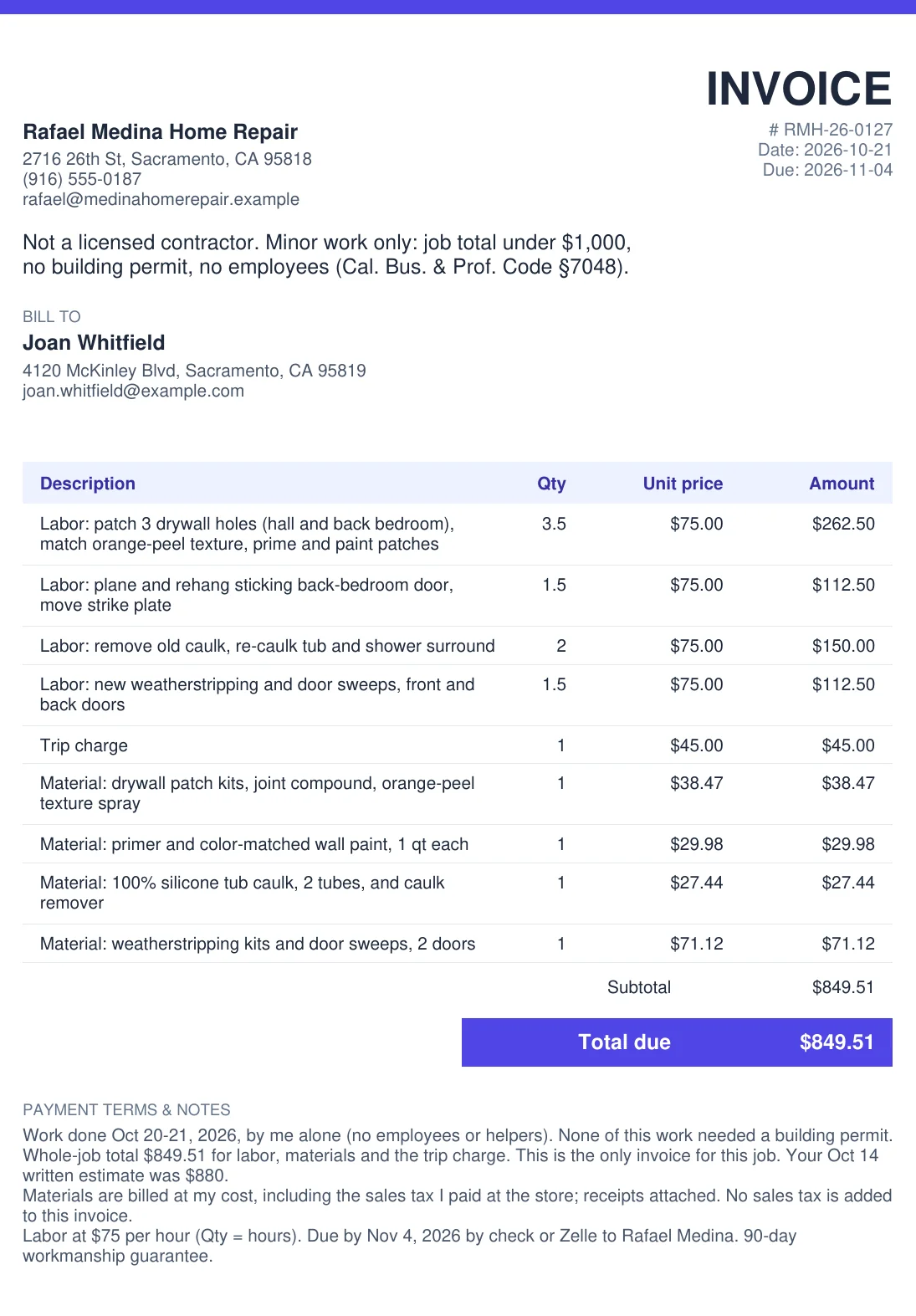
Your name or business name, address, phone and email, the customer's name and the job address, a unique invoice number and the dates you did the work. Then one line per task with the hours (or a flat price), any trip or service-call charge, and the materials on their own lines. Finish with the total, the due date and how to pay. In California, an unlicensed handyman working under the minor-work exemption should be able to show that the whole job, labor and materials together, came to less than $1,000, needed no building permit and used no employees. The example says so in the License and Notes fields.
Line items handymen actually bill
- Labor per task, with the hours: "Patch 3 drywall holes (hall and back bedroom), match orange-peel texture, prime and paint patches", 3.5 hours. One line per task lets the customer match the invoice to the estimate and see where the time went.
- A trip or service-call charge on its own line, so it is not buried in the hourly rate.
- Materials at cost, grouped by task, with the store receipts attached. If you mark materials up, say so on the line.
- Haul-away or disposal, if you take debris to the dump.
- In California, your license status. A licensed contractor puts the license number here. An unlicensed handyman can state the minor-work conditions instead, as in the example's License field.
California: the $1,000 minor-work limit and your invoice
The rule. California's contractor licensing law does not apply to a job "on one undertaking or project by one or more contracts if the aggregate contract price for labor, materials, and all other items is less than one thousand dollars ($1,000), that work or operation being considered of casual, minor, or inconsequential nature, and the work or operation does not require a building permit." (Business and Professions Code §7048(a), as amended effective January 1, 2026.) The exemption is lost by anyone who advertises or uses a sign or card suggesting they are a contractor or qualified to be one, or who employs another person to do or help with the work (§7048(c)).
It used to be $500. AB 2622 raised the limit from $500 to $1,000 starting January 1, 2025. The Contractors State License Board's bulletin on the change puts the conditions plainly: "if the minor work is subject to a permit requirement of any kind, or if the unlicensed person hires one or more workers to assist or perform the work, a license is required – even if the project is less than $1,000." (CSLB industry bulletin #24-07, December 31, 2024.) Older templates and articles that still say $500 are out of date.
Everything counts. The limit is on the whole job: labor, materials, the trip charge and anything else. Billing by the hour does not get around it; for an unlicensed person who agreed to furnish materials and labor by the hour, the contract price is "the aggregate sum of the cost of materials and labor furnished and the cost of completing the work to be performed" (§7028(f)). That is why the example's notes state the whole-job total and the estimate, and say it is the only invoice for the job.
No splitting. The exemption does not apply where the work is part of a larger operation "or in which a division of the operation is made in contracts of amounts less than one thousand dollars ($1,000) for the purpose of evasion of this chapter or otherwise" (§7048(b)). Two $600 invoices for one kitchen are one $1,200 job.
Advertising. An unlicensed person may advertise construction work only if the job total is under $1,000 "and the person states in the advertisement that the person is not licensed under this chapter" (§7027.2). The law puts that statement on the ad; repeating it on the invoice, as the example does, keeps your paperwork consistent.
Over the line. Contracting without a license when no exemption applies is a misdemeanor, with a fine of up to $5,000, up to six months in county jail, or both for a first conviction (§7028(b)). Where a license is required, an unlicensed person cannot sue to collect for the work, and the customer can sue to get back everything paid (§7031(a) and (b)). CSLB summarizes it: it is illegal for an unlicensed person to work on any project that requires a building permit, uses employee labor, or is "valued at $1,000, or more in combined labor and material costs" (CSLB, What is illegal contractor activity?).
Licensed handymen: the number is still $500. For licensed contractors, a written home improvement contract is required when the aggregate price, including labor, services and materials, exceeds five hundred dollars (§7159(b)). It must be signed before work starts and include your license number, the contract price and, if you take one, the down payment notice: "THE DOWNPAYMENT MAY NOT EXCEED $1,000 OR 10 PERCENT OF THE CONTRACT PRICE, WHICHEVER IS LESS." Your invoice should match that contract.
California: sales tax on handyman materials
Materials. California's construction contractor regulation defines a construction contract to include a contract, on a lump sum or time and material basis, to repair any building, and a construction contractor as any person who agrees to perform and does perform one. Contractors are "consumers of materials which they furnish and install in the performance of construction contracts", so sales or use tax applies when they buy the materials (CDTFA Regulation 1521). Its list of materials includes caulking, paint, wallboard, weather stripping and builders' hardware.
Lump sum vs time and material. CDTFA's guide says "Construction contractors are always the consumers of materials that they furnish and install in the performance of a lump sum contract." On a time and material job the contractor is generally the consumer too, unless it bills the customer sales tax computed on marked-up materials, or the contract transfers title to the materials before installation and states their price separately; then the contractor is the retailer of the materials (CDTFA Publication 9, Construction and Building Contractors, February 2025).
Fixtures are different. Contractors are retailers of fixtures they furnish and install, such as lighting fixtures, plumbing fixtures and Venetian blinds, and tax applies to the fixture's sale price; a contractor who sells fixtures needs a seller's permit (Regulation 1521(b)(2)(B) and (b)(4)).
So the example bills $167.01 of materials at cost, with the tax already paid at the store, and adds no sales tax line; the $637.50 of labor and $45 trip charge carry no tax. Tax % is left at 0.
Other states set their own licensing thresholds and tax rules, and your city or county decides what needs a building permit, so check with your local building department before you quote. This is a summary of the California Business and Professions Code, CSLB guidance and CDTFA rules as of October 2026, not legal or tax advice; confirm with CSLB, CDTFA or your accountant.
FAQ
Should a handyman charge by the hour or by the job?
Either works on this template. By the hour, put the hours for each task in Qty and your rate in Unit price, as in the example (3.5 hours × $75 = $262.50 for the drywall patches). By the job, write each task on a line with Qty 1 and the flat price. Naming the task and the room on each line lets the customer check the invoice against your estimate. In California, billing by the hour does not change the license math: for an unlicensed person who agreed to furnish materials and labor on an hourly basis, the law counts the contract price as the cost of the materials and labor furnished plus the cost of completing the work (Business and Professions Code §7028(f)).
How much work can a handyman do without a license in California?
Less than $1,000 per job, counting labor, materials and everything else, and only if the work needs no building permit and the handyman does it without employees. That is the minor-work exemption in Business and Professions Code §7048, which also does not apply to anyone who advertises or uses a sign or card suggesting they are a contractor or qualified to be one. The limit was $500 until the end of 2024; AB 2622 raised it to $1,000 starting January 1, 2025, and the Contractors State License Board's bulletin on the change stresses the permit and no-employee conditions. Unlicensed handymen may advertise only for jobs under $1,000, and the ad must say they are not licensed (§7027.2).
Does the $1,000 limit include materials and the trip charge?
Yes. Section 7048 counts "the aggregate contract price for labor, materials, and all other items", so the paint, caulk and trip charge count along with your hours. In the example that is $637.50 of labor (8.5 hours × $75) + $45 trip charge + $167.01 of materials ($38.47 + $29.98 + $27.44 + $71.12) = $849.51, under the limit.
Can I split a bigger job into two invoices under $1,000?
No. Section 7048 covers "one undertaking or project by one or more contracts", and it says the exemption does not apply where the work is part of a larger operation "or in which a division of the operation is made in contracts of amounts less than one thousand dollars ($1,000) for the purpose of evasion of this chapter or otherwise". If the customer adds work that pushes the same project to $1,000 or more, the job needs a licensed contractor; a second invoice does not fix it.
What happens if an unlicensed handyman takes a job over $1,000?
Contracting without a license when no exemption applies is a misdemeanor; a first conviction can mean a fine of up to $5,000, up to six months in county jail, or both (§7028). Money is the other risk: where a license is required, an unlicensed person cannot sue to collect payment for the work (§7031(a)), and the customer can sue to recover all compensation paid (§7031(b)). So check the estimate, not just the final invoice, before you start.
Do handymen charge sales tax in California?
Usually not on an invoice like the example. California's construction contractor regulation covers any person who agrees to perform and does perform a contract to repair a building (the definition turns on the work, not on a license) and treats contractors as the consumers of the materials they furnish and install, so you pay sales tax when you buy the materials (Regulation 1521). On a time-and-material job the contractor is generally still the consumer, but CDTFA says you become the retailer of the materials if you bill the customer sales tax computed on your marked-up materials, or if the contract transfers title to the materials before installation and states their price separately (Publication 9). Fixtures, such as light fixtures, plumbing fixtures and blinds, are different: contractors are retailers of fixtures they furnish and install, and selling them requires a seller's permit.
Do I need a written contract for handyman work in California?
A licensed contractor does once the job is over $500. California's home improvement contract rules apply when the aggregate contract price, including labor, services and materials, exceeds $500 (§7159(b)), so the $1,000 figure does not carry over. That contract must be in writing and signed before work starts, and it must include, among other things, the license number, in most cases a notice of the buyer's right to cancel, and, if there is a down payment, the notice that it may not exceed $1,000 or 10 percent of the contract price, whichever is less. For an unlicensed handyman relying on §7048, the section says the contractors chapter, which includes §7159, does not apply to qualifying minor work. A short written estimate with the scope and price is still the easiest way to show the job was under $1,000.
Is InvoiceSnap free?
Yes. You can fill in the invoice and download a watermarked preview PDF free with no signup. A clean PDF is $4 one-time for 7 days of unlimited invoices (USDC; card coming soon).
Is my data uploaded?
No. The PDF is generated in your browser; your client and pricing details are not sent to a server.
More invoice templates
Freelance invoice template (fill online → PDF) · Independent contractor invoice template · Hourly invoice template (hours worked) · Consulting invoice template · Invoice with a discount line · Invoice template for international clients · Photography invoice template · Cleaning invoice template · Landscaping & lawn care invoice template · Plumbing invoice template · Electrician invoice template · HVAC invoice template · Roofing invoice template · Painting invoice template · InvoiceSnap home