What should a roofing invoice include?
Your company name, address and phone number, the homeowner's name and the property address, a unique invoice number, the dates the work was done, and the roof size in squares (one square is 100 sq ft of roof). Then one line per charge: tear-off and install labor by the square, replaced decking by the sheet, shingles by the bundle with the product type, underlayment and ice and water shield, starter, ridge cap, drip edge, pipe boots and vents, and the dumpster or haul-off. Finish with the subtotal, sales tax where it applies, the total due, your workmanship warranty and how to pay. On an insurance job, add the claim number and say in plain words that the deductible was not waived.
Line items roofers actually bill
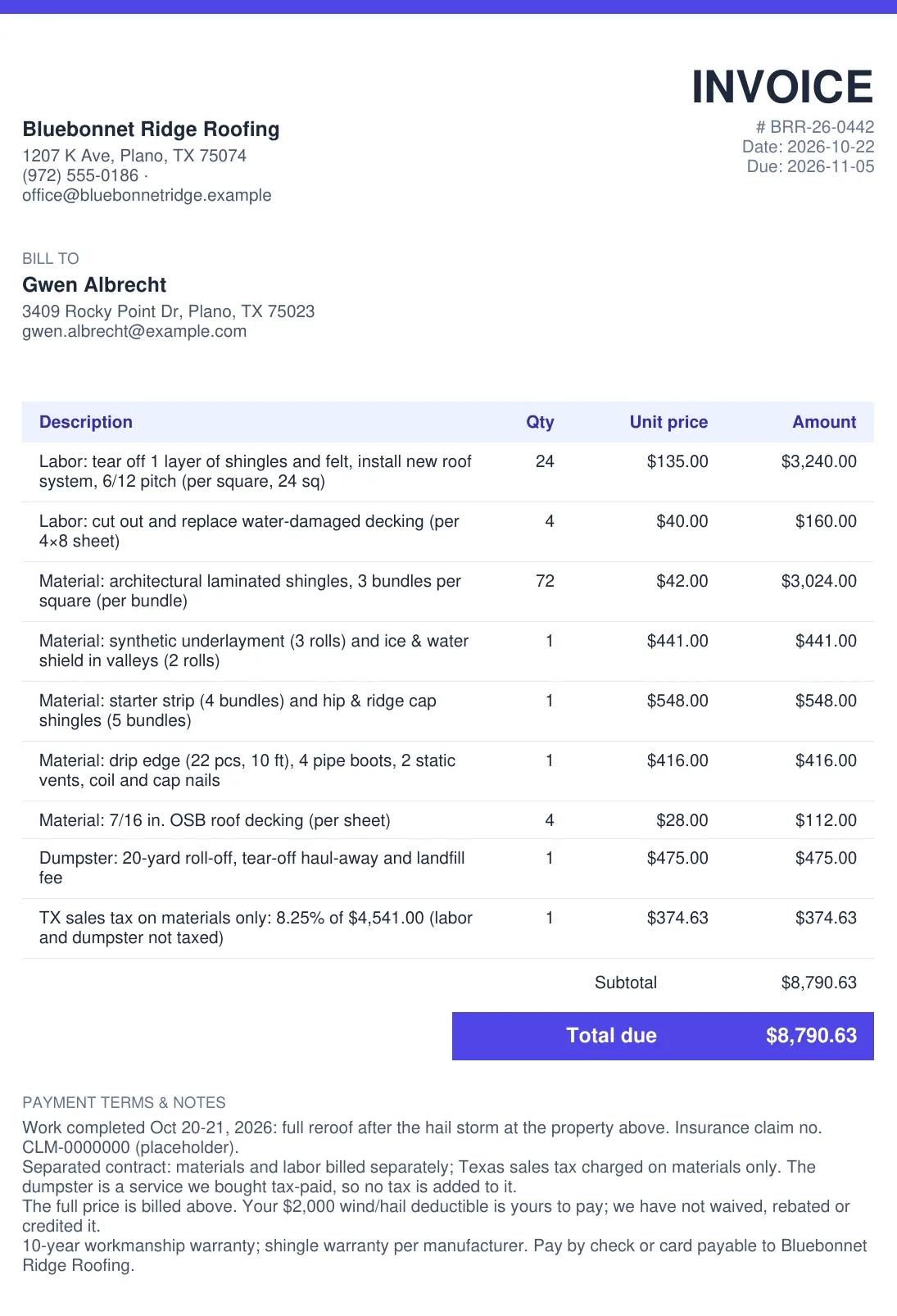
- Tear-off and install by the square: "Tear off 1 layer of shingles and felt, install new roof system, 6/12 pitch", 24 in Qty and the per-square price in Unit price. Put the pitch and the number of layers in the description, because both change the price.
- Decking by the sheet: the sheets you cut out and replaced, with the labor and the OSB or plywood on separate lines. This is the line homeowners ask about, so the count matters.
- Shingles by the bundle: three bundles per square for most architectural shingles, with the product type in the description, so the warranty registration matches the invoice.
- Underlayment, ice and water shield, starter and ridge cap: the rolls and bundles used, grouped on one or two lines.
- Flashing, drip edge, pipe boots and vents on one line with counts.
- The dumpster or haul-off on its own line. In Texas it is taxed differently from the materials (see below).
- For insurance jobs, the claim number and a plain statement about the deductible in the notes.
Texas: insurance jobs, the deductible and sales tax
The deductible. A person insured under a property insurance policy "shall pay any deductible applicable to a first-party claim made under the policy" (Texas Insurance Code §707.002). Texas Business and Commerce Code §27.02(b) says a contract for goods or services that is reasonably expected to be paid wholly or partly from a property insurance claim, with a contract price of $1,000 or more, "must contain the following notice in at least 12-point boldfaced type":
"Texas law requires a person insured under a property insurance policy to pay any deductible applicable to a claim made under the policy. It is a violation of Texas law for a seller of goods or services who reasonably expects to be paid wholly or partly from the proceeds of a property insurance claim to knowingly allow the insured person to fail to pay, or assist the insured person's failure to pay, the applicable insurance deductible."
Section 27.02(c) makes it a Class B misdemeanor to pay, waive, absorb or decline to collect the deductible without the insurer's consent, to give a rebate or credit that offsets it, to help the insured avoid paying it in any other way, or to advertise or promise any of that (Texas Business and Commerce Code §27.02, as amended by H.B. 2102, effective September 1, 2019). The notice requirement is about the contract. An invoice is not the contract, so put the notice in your signed agreement at 12-point bold. InvoiceSnap prints notes at 10 pt, so the example's notes carry a short deductible statement and do not try to stand in for the contract notice.
On a replacement-cost policy, the insurer can refuse to pay withheld recoverable depreciation or a replacement-cost holdback until it receives reasonable proof that the policyholder paid the deductible. That proof includes a canceled check, a money order receipt, a credit card statement, or a signed installment plan or other financing that requires full payment of the deductible over time (Insurance Code §707.004). TDI says replacement-cost claims are paid in two checks, the second after repairs have started (TDI, Insurance and your roof), and its deductible page names an estimate inflated so the extra covers the deductible as one form of the illegal waiver.
Don't act as the adjuster. A contractor may not act as a public adjuster or advertise to adjust claims for any property where it is providing or may provide contracting services (Insurance Code §4102.163). TDI's guidance for roofers lists offering to negotiate claim settlements and telling insurance companies that you represent the policyholder as problem conduct (TDI, Roofing and insurance: Know the law). That is why the example is addressed to the homeowner and only references the claim number.
Sales tax. The Texas Comptroller says labor to repair, remodel or restore residential real property (houses, apartments, condos, nursing homes and retirement homes, but not hotels or rentals of less than 30 days) is not taxable. On a lump-sum residential job you pay tax on materials when you buy them and do not charge the homeowner tax. On a separated contract you give suppliers a resale certificate and collect state and local sales tax from the customer on the materials charge, which must be at least what you paid; the construction labor charge is not taxable. For nonresidential property the Comptroller says "Repair or remodeling includes reroofing", and that work is taxable on the total charge. The exception is labor to repair nonresidential property damaged in an area declared a natural disaster by the President or the Governor, when the billing states labor and materials separately (Texas Comptroller publication 94-116, Real Property Repair and Remodeling).
The contractor rule says a contractor on a separated contract "may not issue a resale certificate for a taxable service that the contractor uses or consumes", and names "daily clean-up (janitorial service or garbage collection and removal) of the construction site" (34 TAC §3.291(b)(4)(D), official Texas Administrative Code). The example roofer therefore pays tax on the dumpster when it rents it and adds none on the invoice. It taxes the $4,541 of materials and not the $3,400 of labor or the $475 dumpster. Texas state tax is 6.25% and local jurisdictions can add up to 2%, for a maximum combined rate of 8.25% (Texas Sales and Use Tax). Plano is at that 8.25%: 1% city plus 1% Dallas MTA (Comptroller city rate table). Check the rate for the job address before you bill.
Other states have their own deductible and sales-tax rules. This is a summary of the Texas statutes and published guidance, not legal or tax advice, so confirm with the Comptroller, TDI or your attorney or accountant.
FAQ
How do I write a roofing invoice for an insurance claim?
Bill the homeowner, not the insurer, at the full price of the job, with the claim number in the notes. Itemize it the way an adjuster's estimate is itemized (squares of tear-off and install, sheets of decking, bundles of shingles, underlayment, flashing and vents, dumpster), so the homeowner can lay the two side by side. Don't knock the deductible off the price. In Texas the policyholder has to pay the deductible (Insurance Code §707.002), and on a replacement-cost policy the insurer can hold back recoverable depreciation until it gets reasonable proof that the deductible was paid, such as a canceled check, a money order receipt, a credit card statement or a signed installment plan (§707.004). A paid invoice plus the payment record is what the homeowner sends in. TDI explains that replacement-cost claims are usually paid in two checks, the second after repairs have started.
Can a roofer waive or pay the deductible in Texas?
No. Under Texas Business and Commerce Code §27.02, a seller of goods or services commits a Class B misdemeanor if, on a job paid from a property insurance claim and without the insurer's consent, it pays, waives, absorbs or declines to collect the deductible, gives a rebate or credit that offsets it, or helps the insured avoid paying it in any other way. Advertising or promising to do so is also an offense. The Texas Department of Insurance says an estimate padded above the real cost so the extra covers the deductible is one way this happens. A contract of $1,000 or more that is reasonably expected to be paid from insurance proceeds must also carry the notice quoted on this page, in at least 12-point boldfaced type.
Do roofers charge sales tax in Texas?
On a house, not on the labor. The Texas Comptroller says labor to repair, remodel or restore residential real property is not taxable. On a lump-sum residential job (one price for everything) you pay tax on materials when you buy them and do not charge the homeowner tax. On a separated contract (materials and labor priced separately) you buy materials with a resale certificate and collect state and local tax on the materials charge, which must be at least what you paid for them. Commercial roofs are different: the Comptroller lists reroofing as repair or remodeling, and repairing or remodeling nonresidential property is taxable on the total charge (publication 94-116). The labor to repair nonresidential property damaged in a declared disaster area is not taxable when labor and materials are stated separately.
How do I charge sales tax on materials only in InvoiceSnap?
InvoiceSnap applies its Tax % field to the whole subtotal, so for a separated residential job leave Tax % at 0 and add the tax as its own line, as in the example: "TX sales tax on materials only: 8.25% of $4,541.00", Qty 1, Unit price $374.63. The materials are 72 bundles × $42 ($3,024) + $441 + $548 + $416 + 4 sheets × $28 ($112) = $4,541, and 8.25% of that is $374.6325, which rounds to $374.63. With $3,400 of labor (24 squares × $135 plus 4 sheets × $40) and the $475 dumpster, the total is $8,790.63. For a commercial reroof, where Texas taxes the total charge, put the rate in the Tax % field instead.
Should I charge sales tax on the dumpster?
The example doesn't. Under the Comptroller's contractor rule, a contractor on a separated contract cannot use a resale certificate for a taxable service it uses up on the job, and the rule names daily clean-up, including garbage collection and removal at the construction site. So the roofer pays tax to the dumpster company and bills the dumpster as its own untaxed line. Final clean-up (janitorial service) of the site is the exception the rule lists as resold to the customer and taxed when separately stated (34 TAC §3.291(b)(4)(D)). If your setup is different, ask the Comptroller.
Should a roof be billed by the square or as one price?
Either works on this template. By the square, put the number of squares in Qty and your per-square price in Unit price, then bill extras such as decking by the sheet or extra layers of tear-off on their own lines, so a change from the estimate is easy to see. As one price, write the job on a single line with Qty 1. In Texas the choice also decides the tax: one price for labor and materials is a lump-sum contract with no tax charged to the homeowner, and separate labor and materials prices make it a separated contract with tax on the materials.
Is InvoiceSnap free?
Yes. You can fill in the invoice and download a watermarked preview PDF free with no signup. A clean PDF is $4 one-time for 7 days of unlimited invoices (USDC; card coming soon).
Is my data uploaded?
No. The PDF is generated in your browser; your client and pricing details are not sent to a server.
More invoice templates
Freelance invoice template (fill online → PDF) · Independent contractor invoice template · Hourly invoice template (hours worked) · Consulting invoice template · Invoice with a discount line · Invoice template for international clients · Photography invoice template · Cleaning invoice template · Landscaping & lawn care invoice template · Plumbing invoice template · Electrician invoice template · HVAC invoice template · Painting invoice template · InvoiceSnap home