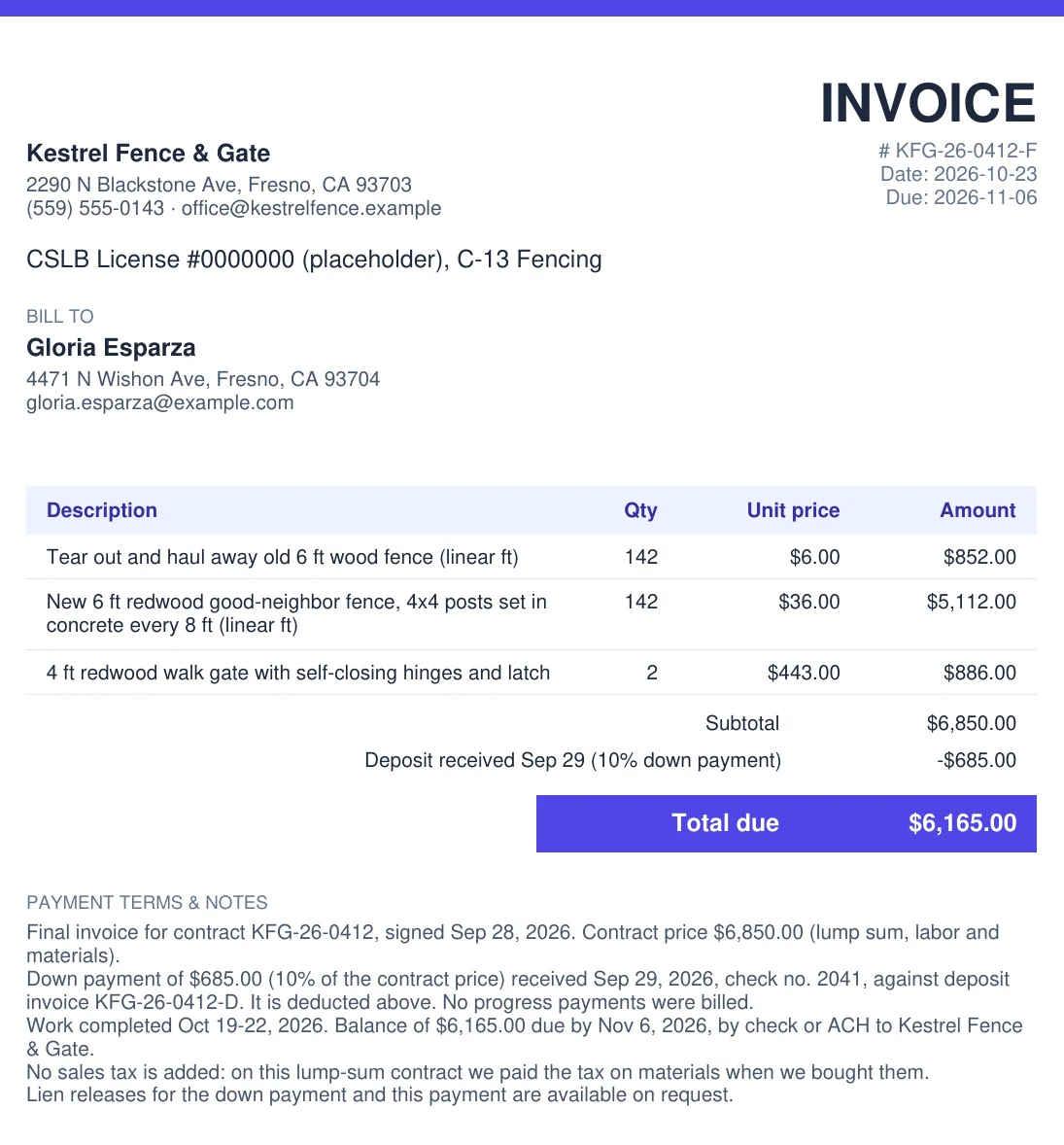
How do you invoice a deposit?
With two invoices. First a deposit invoice with one line, for example "Down payment, 10% of contract price $6,850.00", $685.00, which references the quote or contract and is due before work starts. When the job is done, send the final invoice: list the full price of the work, then subtract the deposit on its own line labelled "Deposit received" with the date it was paid, so the total due is the balance. In the example that is $6,850.00 − $685.00 = $6,165.00. In InvoiceSnap, enter the deposit in the Discount field, set it to Fixed and rename the label.
The two documents, side by side
A deposit is billed twice: once on its own, and once more as a deduction on the final invoice. Here are both for the example job.
| 1. Deposit invoice | 2. Final invoice (pre-filled above) | |
|---|---|---|
| Number | KFG-26-0412-D | KFG-26-0412-F |
| Date | Sep 28, 2026 (contract signed) | Oct 23, 2026 (day after completion) |
| Lines | Down payment, 10% of contract price $6,850.00: $685.00 | Tear-out 142 ft × $6 = $852.00 Fence 142 ft × $36 = $5,112.00 2 gates × $443 = $886.00 |
| Subtotal | $685.00 | $6,850.00 |
| Deposit received | — | −$685.00 |
| Total due | $685.00, due on signing | $6,165.00, due Nov 6 |
To make the deposit invoice in InvoiceSnap, change the invoice number to the -D version, replace the three lines with the single down payment line, and set Discount to 0. To make the final invoice, use the example as it is.
What to put on each
- Deposit invoice: the quote or contract number, the full contract price, the deposit as a dollar amount (and the percentage, if your contract states one), what it secures (a date, materials order or start of work), and when it is due.
- Final invoice: the work at full price, a "Deposit received" line with the payment date, any progress payments already received, and the balance. Repeat the deposit invoice number and payment method in the notes.
- More than one payment received? InvoiceSnap has one deduction line, so add the payments together in the Discount field and label it, for example, "Deposit and progress payment received", then list each payment with its date in the notes.
California home improvement: the down payment cap
The limit. "If a downpayment will be charged, the downpayment shall not exceed one thousand dollars ($1,000) or 10 percent of the contract amount, whichever amount is less." (Business and Professions Code §7159.5(a)(3).) The section covers home improvement contracts between an owner or tenant and a licensed contractor, or one who should be licensed. Home improvement includes work on fences, driveways, swimming pools, patios, landscaping, porches and garages (§7151). In the example, 10% of $6,850 is $685, so $685 is the most Kestrel could take up front. On any contract above $10,000 the cap is $1,000.
No exceptions for special orders. The Contractors State License Board puts it bluntly: the down payment cannot be more than $1,000 or 10% of the contract price, whichever is less, "for a home improvement job or swimming pool, excluding finance charges. There are no exceptions for special-order materials." (CSLB, Learn About Home Improvement Contracts.)
After the deposit, bill only for work done. "Except for a downpayment, the contractor shall neither request nor accept payment that exceeds the value of the work performed or material delivered." (§7159.5(a)(5).) Payments before completion must be listed in the contract as a schedule of progress payments, in dollars and cents, tied to specific work or materials (§7159.5(a)(4)). The example has none: the balance is billed once the fence is finished.
The contract has to say it. A home improvement contract over $500 (§7159(b)) that takes a down payment needs the heading "Downpayment", the amount, and this statement in at least 12-point bold: "THE DOWNPAYMENT MAY NOT EXCEED $1,000 OR 10 PERCENT OF THE CONTRACT PRICE, WHICHEVER IS LESS." (§7159(d)(8).) Your deposit invoice should match that number.
Lien releases. After any payment, and before the next one, the contractor must, if asked, give the customer a full and unconditional lien release for the work paid for, and the customer may hold back further payments until it is provided (§7159.5(a)(6)). That is why the example's notes offer releases for both payments.
Exemption and penalties. Contractors who furnish a performance and payment bond, lien and completion bond, or registrar-approved bond equivalent or joint control covering full performance and payment are exempt from the down payment and progress payment limits (§7159.5(a)(8)). For everyone else, violating the down payment rule or the payment-for-work-done rule is a misdemeanor: a fine of $100 to $5,000, up to one year in county jail, or both; in a declared disaster area the court must impose the maximum fine (§7159.5(b)(1)).
Sales tax in the example
California treats a construction contract "whether on a lump sum, time and material, cost plus, or other basis" to construct, alter or repair an improvement to real property the same way for materials: "Construction contractors are consumers of materials which they furnish and install in the performance of construction contracts." Sales or use tax applies when the contractor buys them (CDTFA Regulation 1521). So the example adds no sales tax line, and Tax % is 0. Fixtures and some time-and-material arrangements are treated differently, and other states have their own rules.
UK: VAT on deposits
HMRC's rule: "Most deposits serve primarily as advance payments and will create tax points under paragraph 14.2.2(a) when you receive them. Some types of deposit are not a consideration for a supply and their receipt does not create a tax point." Its example of the second kind is a deposit taken as security for the safe return of hired goods (VAT Notice 700, section 14.2.3, last updated 25 June 2026). So a VAT-registered business normally charges VAT on the deposit invoice and only on the balance on the final invoice. Enter the deposit net of VAT in the Discount field and InvoiceSnap does that arithmetic for you, as in the £4,800 worked example in the FAQ below.
This is a summary of the California Business and Professions Code, CSLB and CDTFA guidance and HMRC VAT Notice 700 as of October 2026, not legal or tax advice. Check your own contract, state or country rules with a lawyer or accountant.
FAQ
How do I show a deposit already paid on the final invoice?
Put the deposit amount in the Discount field, set the type to Fixed, and change the label to something like "Deposit received Sep 29". The PDF then shows Subtotal, the deposit line with a minus sign, and Total due, which is the balance. Repeat the deposit invoice number, the payment date and how it was paid in the notes (the example says "check no. 2041, against deposit invoice KFG-26-0412-D"), so the customer and your bookkeeper can match the two documents.
What if the invoice has sales tax or VAT?
InvoiceSnap subtracts the Discount line before it applies Tax %. If you already charged tax on the deposit invoice (as with UK VAT, where most deposits create a tax point when received), enter the deposit's pre-tax amount: the final invoice then taxes only the remaining balance. Example: a £5,000 job with a £1,000 + £200 VAT deposit gives £5,000 − £1,000 = £4,000, plus 20% VAT £800, total due £4,800. If you did not charge tax on the deposit and tax is due on the full price, leave Tax % at 0, add the tax as its own line computed on the full price, and then subtract the deposit.
How much deposit can a contractor ask for in California?
On a home improvement contract, no more than $1,000 or 10% of the contract price, whichever is less (Business and Professions Code §7159.5(a)(3)). On the example's $6,850 fence that is $685, because 10% is under $1,000; on a $14,000 kitchen remodel, 10% would be $1,400, so the cap is $1,000. The Contractors State License Board adds that the limit covers home improvement jobs and swimming pools and that "There are no exceptions for special-order materials." Home improvement explicitly includes fences, driveways, patios, landscaping and garages (§7151). Contractors who furnish a qualifying performance and payment bond, lien and completion bond or approved joint control are exempt from the cap (§7159.5(a)(8)).
Can a California contractor ask for 50% up front?
Not on a home improvement job, unless it is covered by the bond exemption. Apart from the down payment, the contractor "shall neither request nor accept payment that exceeds the value of the work performed or material delivered" (§7159.5(a)(5)), and any payments due before completion have to be listed in the contract as a schedule of progress payments tied to specific work (§7159.5(a)(4)). Breaking the down payment or progress payment rules is a misdemeanor, with a fine of $100 to $5,000, up to a year in county jail, or both (§7159.5(b)(1)). Outside those rules, for example a freelance design project, a 50% deposit is whatever your contract says: bill it as one line, Qty 1, at half the price.
Does a deposit have VAT?
In the UK, usually yes. HMRC's VAT guide says "Most deposits serve primarily as advance payments and will create tax points under paragraph 14.2.2(a) when you receive them." A deposit taken only as security, such as one refunded when hired goods come back safely, creates no tax point. If the customer cancels and you keep a deposit that was a part payment, VAT is still due on it: "VAT is due on all charges, deposits and fees which are full or part payments for a supply of goods or services" (VAT Notice 700, sections 14.2.3 and 8.13.1).
What is the difference between a deposit invoice and a proforma invoice?
A deposit invoice bills part of an agreed price, and the deposit is deducted later on the final invoice. A proforma is closer to a priced offer. HMRC describes proformas as "often used to offer goods or services to potential customers", says they cannot be used as evidence to reclaim input tax, and says they should be clearly marked "this is not a VAT invoice" (VAT Notice 700, section 17.3). For a UK VAT-registered business that has agreed the deal and taken the money, the deposit should go on a proper VAT invoice.
Should the final invoice show the full price or just the balance?
Show the full price, then subtract the deposit. A final invoice with only "Balance: $6,165.00" leaves the customer to work out what it covers, and it does not match the contract. Listing the scope at full price, then "Deposit received" and the balance, lets anyone check that contract price − deposit = amount due, and it gives you one document that shows what was paid in total.
Is InvoiceSnap free?
Yes. You can fill in the invoice and download a watermarked preview PDF free with no signup. A clean PDF is $4 one-time for 7 days of unlimited invoices (USDC; card coming soon).
Is my data uploaded?
No. The PDF is generated in your browser; your client and pricing details are not sent to a server.
More invoice templates
Freelance invoice template (fill online → PDF) · Independent contractor invoice template · Hourly invoice template (hours worked) · Consulting invoice template · Invoice with a discount line · Invoice template for international clients · Photography invoice template · Cleaning invoice template · Landscaping & lawn care invoice template · Plumbing invoice template · Electrician invoice template · HVAC invoice template · Roofing invoice template · Painting invoice template · Handyman invoice template · InvoiceSnap home