What should a graphic design invoice include?
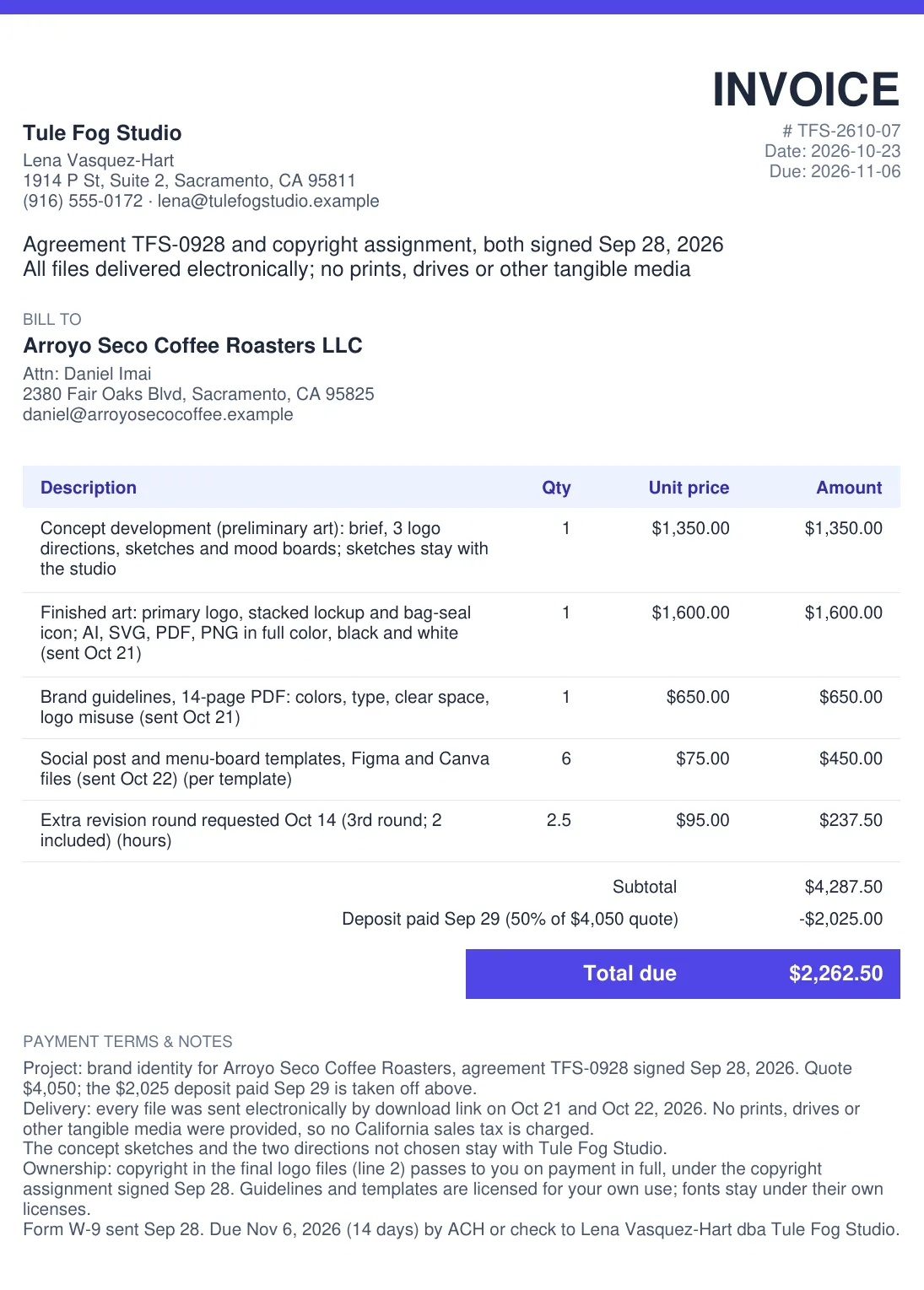
Your name or studio name and contact details, the client's legal name, an invoice number and date, the agreement or quote it bills against, and one line per deliverable: concept development, the finished art with the file types, guidelines or templates, and any revision rounds beyond the number included, with the hours. Then the deposit you already took, sales tax if your state charges it, the total, the due date and how to pay. Two notes save arguments later: how the files were delivered and when copyright passes to the client. The example: $4,287.50 of work, a $2,025.00 deposit taken off, no California tax because nothing tangible was delivered, $2,262.50 due.
Line items graphic designers actually bill
- Concept development: the brief, the directions you showed, sketches and mood boards. Label it as concept work or preliminary art and say who keeps the sketches.
- Finished art, with what was made (logo, lockups, icon) and the file types, and the date sent.
- Guidelines, templates and extra pieces, one line each, with page or template counts.
- Revisions beyond the number included, with the round, the date asked for and the hours.
- The deposit taken off at the end, with the date paid.
- Delivery and ownership in the notes: how the files went out, and when copyright passes under the signed assignment.
How the example adds up
| Part of the invoice | California tax? | Amount |
|---|---|---|
| Concept development | No: separately stated, sketches kept by the studio | $1,350.00 |
| Finished logo files | No: sent by download link only | $1,600.00 |
| Brand guidelines PDF | No: sent by download link only | $650.00 |
| Templates | No: 6 × $75, sent by download link only | $450.00 |
| Extra revision round | No: 2.5 h × $95, part of the electronic files | $237.50 |
| Work billed | $1,350 + $1,600 + $650 + $450 + $237.50 | $4,287.50 |
| Deposit paid Sep 29 | 50% of the $4,050 quote for lines 1-4 | −$2,025.00 |
| Total due | $4,287.50 − $2,025.00, by Nov 6 | $2,262.50 |
The same work billed from Austin to an Austin client would look different. Austin (Travis Co) is 1% city tax plus 1% Austin MTA on top of the 6.25% state rate, 8.25% in all, per the Comptroller's city rate table. Taxing lines 2 to 5 ($2,937.50) gives $242.34; taxing all five lines ($4,287.50) gives $353.72. Which of the two applies is the open question described under Texas below. The studio, the client, the prices and the agreement numbers are made up for the arithmetic.
In InvoiceSnap. The deposit goes in the Discount field with its own label, the Tax % field stays at 0, and the agreement and delivery note sit in the License field so they print under your name.
California: no tax on files sent electronically
The rule. "However, if you transfer your product electronically and do not include any tangible product as part of your sale, tax does not apply." (CDTFA publication 37, Graphic Design, Printing, and Publishing, April 2022.) Regulation 1540, which covers "commercial artists, commercial photographers, or designers", says "A transfer of electronic artwork in tangible form is a sale." and "A transfer of electronic artwork is not in tangible form if the file containing the electronic artwork is transferred through remote telecommunications (such as by modem or over the Internet), or if the file is loaded into the client's computer by the advertising agency or commercial artist, and the client does not obtain title to or possession of any tangible personal property, such as electronic media or hard copy." (Regulation 1540(b)(2)(B).)
Anything tangible changes it. "Sales tax will apply if you provide your customer with a copy of the electronically transferred product in any sort of tangible form such as a copy of the product on a CD or other storage media, a tangible print, copy, or transparency of the product." (publication 37). The example's notes say no prints, drives or other media were provided, and the License field repeats it.
Say so on the invoice. Publication 37 asks you to keep proof of the electronic transfer, such as the email that sent the files, and adds: "You may also note on your sales invoice that the product was transferred electronically and the date transferred." The example gives both dates, Oct 21 and Oct 22.
Concept work. "Your itemized charges for concept and design services that create preliminary art are not taxable when all of the following conditions apply:" the list includes "You retain ownership and permanent possession of the preliminary art used to convey the idea or concept" and "Nothing in your contract transfers title to the preliminary art or the right to permanent possession to your customer." It goes on: "However, you may transfer to your customer the ownership of the intellectual property embodied in the art (ideas, concepts, designs, etc.), or agree not to use the preliminary art for any other customer." So the example keeps the sketches, and its assignment covers the copyright in the final files, not the sketches themselves.
Websites too. If you also build the client's site: "Generally, the design, creation, or hosting of a website is not taxable because the product you provide is electronic, not tangible." (publication 37). Texas taxes it; see the web design invoice template.
Texas: taxed even when you email the files
The rule. "Photographers, commercial artists, portrait painters, and persons who draw, paint, engrave, and etch are graphic artists." and "Sales tax is due and should be collected by the graphic artist from the customer on the total charge for the art." (34 TAC §3.312(a)(1) and (a)(3), last amended in 1992.) Sending the files electronically doesn't help: "Except as otherwise provided by this chapter, the sale or use of a taxable item in electronic form instead of on physical media does not alter the item's tax status." (Tex. Tax Code §151.010.)
Logos by name. A 1998 Comptroller letter to one designer: "The creation of graphics or logos using a drawing program for a clients homepage is considered taxable graphic art per enclosed Rule 3.312." (STAR 9803168L.) In a 2009 contested case about design and layout work for cards, banners, brochures and flyers, the decision said "Petitioner’s argument that it only viewed the design electronically is irrelevant." (STAR 200904347H.) Letters and decisions answer one taxpayer's facts; the rule and statute are what apply to everyone.
The concept line is the open question. The advertising agency rule lists "creative concept development" among nontangible services, but only "Unless related to the sale of employee-fabricated property or the sale of other taxable items", and defines preliminary art as "Roughs, visualizations, layouts, and comprehensives submitted by an advertising agency to its clients for the client's approval of the advertising concept or message prior to the preparation of finished art." (34 TAC §3.321(a)(5) and (a)(6).) The 2009 decision read it so that rejected preliminary art is an untaxed design service, but "if a portion of the preliminary art is incorporated into a finished art, the charge for the incorporated portion is subject to tax as the sale of tangible personal property." The example's concept line covers both the chosen direction and two rejected ones, which is why we show a range ($242.34 to $353.72) for Austin instead of one number.
Washington: graphic design for advertising is taxable
"Starting Oct. 1, 2025, businesses must collect retail sales tax on advertising services." (Washington DOR special notice.) The definition, from ESSB 5814, covers "All digital and nondigital services related to the creation, preparation, production, or dissemination of advertisements" including "Layout, art direction, graphic design, mechanical preparation, production supervision, placement, referrals, acquisition of advertising space, and rendering advice concerning the best methods of advertising products or services." (interim guidance for advertising services.) Neither page says whether a logo or brand identity that isn't tied to a particular advertisement is "related to the creation" of advertisements, so we don't answer that for the example.
Who owns the logo
Only a signed transfer moves the copyright. A transfer "is not valid unless an instrument of conveyance, or a note or memorandum of the transfer, is in writing and signed by the owner of the rights conveyed or such owner's duly authorized agent." (17 U.S.C. §204(a).) The invoice can point to the assignment; it isn't the assignment.
Work made for hire rarely fits a logo. For a non-employee, the work has to be one of nine listed kinds and the parties must sign an agreement, and only "if the parties expressly agree in a written instrument signed by them that the work shall be considered a work made for hire." (17 U.S.C. §101); "If a work fails to satisfy any of these requirements, it is not a work made for hire." (Copyright Office Circular 30.) A logo isn't on the list by name.
In California the wording has a cost. Under Labor Code §3351.5(c), "employee" includes "Any person while engaged by contract for the creation of a specially ordered or commissioned work of authorship in which the parties expressly agree in a written instrument signed by them that the work shall be considered a work made for hire, as defined in Section 101 of Title 17 of the United States Code, and the ordering or commissioning party obtains ownership of all the rights comprised in the copyright in the work." Unemployment Insurance Code §686: "The ordering or commissioning party shall be the employer of the author of the work for the purposes of this part."
Assignments can be ended after 35 years. "Termination of the grant may be effected at any time during a period of five years beginning at the end of thirty-five years from the date of execution of the grant" (17 U.S.C. §203(a)(3)); Circular 30: "These termination provisions, however, do not apply to works made for hire." That is the trade-off behind the example's plain assignment.
The 1099 threshold is now $2,000
"For tax years beginning after 2025, the minimum threshold amount for reporting certain payments required to be reported on certain information returns and/or perform backup withholding on those payments increased to $2,000 and may be adjusted for inflation beginning in calendar year 2027." Business clients "File Form 1099-NEC, Nonemployee Compensation, for each person in the course of your business during the year to whom you have paid at least $2,000 in:" services by non-employees; card and app payments go on Form 1099-K instead (IRS Instructions for Forms 1099-MISC and 1099-NEC, 12/2026). The example's client pays a sole proprietor by ACH or check, so the notes record the W-9.
Where the rules don't line up
- California and Texas reach opposite answers on the same files. California asks whether anything tangible changed hands; Texas taxes the art and says electronic form "does not alter the item's tax status". A California designer with a Texas client, or the reverse, needs to check where the sale is sourced; we didn't.
- Texas concept work. §3.312 taxes "the total charge for the art", §3.321 lists "creative concept development" as a nontangible service unless related to a taxable sale, and the 2009 decision taxed only the part of preliminary art incorporated into finished art. §3.321 is written for advertising agencies; how far it applies to a solo designer is not stated. Hence the range above.
- Proof of electronic delivery. Publication 37 suggests a note on the invoice and a copy of the email that sent the files. Regulation 1540 asks for a signed statement only when the designer loads the files onto the client's computer in person; for files sent over the internet it doesn't prescribe a form. The example does what publication 37 suggests.
- Publication 37 is from April 2022 and says itself: "If there is a conflict between the text in this publication and the law, decisions will be based on the law and not on this publication." We found no conflict with Regulation 1540 on the points used here.
What we did not check
- Graphic design tax in any state other than California, Texas and Washington, Washington rates and B&O tax, and whether Washington taxes logos.
- Sourcing when designer and client are in different states, and California district taxes (the example charges no tax, so no rate was needed).
- California tax on printed matter, reproduction-rights fees and the lump-sum 75/25 method beyond the quotes above; when tax is due on a deposit.
- Font, stock image and template licenses resold to the client.
- Trademark registration and ownership of the logo as a trademark, and how California applies Labor Code §3351.5(c) and UI Code §686 in practice.
- Typical design prices; the example's are made up.
This is a summary of CDTFA publication 37 (April 2022) and Regulation 1540, 34 TAC §§3.312 and 3.321, Tex. Tax Code §151.010, STAR 9803168L and 200904347H, the Texas city rate table, the Washington DOR advertising services notice and interim guidance, California Labor Code §3351.5 and Unemployment Insurance Code §686, 17 U.S.C. §§101, 203 and 204, Copyright Office Circular 30, and the IRS 2026 Instructions for Forms 1099-MISC and 1099-NEC, as read on October 25, 2026, not legal or tax advice. Check with the CDTFA, the Texas Comptroller, the Washington DOR, or your accountant or attorney.
FAQ
How do I make an invoice for graphic design work?
Start from the signed quote and copy its parts onto separate lines: concept development, finished art, guidelines, templates or extra pieces, then revisions beyond what the quote included, with hours in Qty and your rate in Unit price. Enter the deposit in the Discount field and rename it, as the example does ("Deposit paid Sep 29 (50% of $4,050 quote)"). Put the agreement number in the License field, and the delivery method, ownership and payment terms in the notes. In InvoiceSnap the totals update as you type and the free preview PDF shows the finished invoice.
Is graphic design taxable in California?
Not when you deliver it electronically and hand over nothing tangible. CDTFA publication 37 says: "However, if you transfer your product electronically and do not include any tangible product as part of your sale, tax does not apply." Regulation 1540 puts it this way: "A transfer of electronic artwork in tangible form is a sale." A file sent over the internet is not in tangible form as long as the client gets no media or hard copy. Printed proofs, prints, or a USB drive change that: "Sales tax will apply if you provide your customer with a copy of the electronically transferred product in any sort of tangible form such as a copy of the product on a CD or other storage media, a tangible print, copy, or transparency of the product." The example's files all went by download link, so it charges no tax.
Is graphic design taxable in Texas?
Yes, even when you send the files by email. Texas's rule for graphic arts says "Sales tax is due and should be collected by the graphic artist from the customer on the total charge for the art." (34 TAC §3.312(a)(3)), and the Tax Code says "the sale or use of a taxable item in electronic form instead of on physical media does not alter the item's tax status." (§151.010). A 1998 Comptroller letter told one designer "The creation of graphics or logos using a drawing program for a clients homepage is considered taxable graphic art per enclosed Rule 3.312." If the example's studio and client were in Austin (8.25%), lines 2 to 5 would carry $242.34 of tax; whether the concept line is taxed too is less clear (see below), and if it is, the tax would be $353.72.
Is graphic design taxable in Washington state?
Graphic design for advertising is, since October 1, 2025. The Department of Revenue: "Starting Oct. 1, 2025, businesses must collect retail sales tax on advertising services." Its definition includes "Layout, art direction, graphic design, mechanical preparation, production supervision, placement, referrals, acquisition of advertising space, and rendering advice concerning the best methods of advertising products or services." The interim guidance we read does not say whether a logo or brand identity that isn't made for a particular ad counts, so we don't say either way for the example's job. Ask the Department of Revenue before you bill a Washington client for a logo with no tax.
How should I describe logo design on an invoice?
Say what was made and in what form, not just "logo design". The example breaks it into concept development ("brief, 3 logo directions, sketches and mood boards; sketches stay with the studio") and finished art ("primary logo, stacked lockup and bag-seal icon; AI, SVG, PDF, PNG in full color, black and white (sent Oct 21)"). That breakdown matters for tax in California: itemized charges for concept work that creates preliminary art are untaxed when, among other conditions, "You retain ownership and permanent possession of the preliminary art used to convey the idea or concept" (CDTFA publication 37). Listing the file types and the date sent also answers the "where are the files?" email.
Why bill concept development separately from the finished logo?
Because a single price mixes untaxed and taxed work if anything tangible is delivered. Publication 37: "When you itemize charges for conceptual services/preliminary art and finished art, your charges for the preliminary art are generally not taxable and your charges for the tangible finished art are generally taxable." It allows lump sums too, with fixed formulas such as tax on 25% of the charge, but those only matter once something tangible changes hands. Even when everything goes by download, a separate concept line shows the client what the early rounds cost and gives you a clean line to bill if a project is cancelled after the concepts.
What if the client wants printed proofs or the files on a USB drive?
In California that turns the delivery into a sale of tangible property, and the finished art on the drive or in print becomes taxable. Regulation 1540 says a transfer is not in tangible form only if "the client does not obtain title to or possession of any tangible personal property, such as electronic media or hard copy." Publication 37's own example: a designer bills $3,000 for six concept sketches and the client keeps three of them; "Since the customer is keeping three of the sketches, tax applies to $1,500." So if a client asks for a drive or a printed brand book, send the files online anyway and bill the physical item on its own line with tax, or ask the CDTFA how to split it. We did not work out the tax for that case.
Who owns the logo after the client pays?
Whoever the signed paperwork says. A copyright transfer "is not valid unless an instrument of conveyance, or a note or memorandum of the transfer, is in writing and signed by the owner of the rights conveyed or such owner's duly authorized agent." (17 U.S.C. §204(a).) An invoice line that says "all rights transferred" is not signed by you and is not the transfer. The example points to a copyright assignment signed with the agreement that takes effect on payment in full, covering the final logo files only, with the guidelines and templates licensed for the client's own use.
Can a freelance logo be a work made for hire?
Usually not. For someone who isn't your employee, a commissioned work is a work made for hire only if it fits one of nine uses listed in the Copyright Act (a contribution to a collective work, part of a motion picture or other audiovisual work, a translation, a supplementary work, a compilation, an instructional text, a test, answer material for a test, or an atlas) and only "if the parties expressly agree in a written instrument signed by them that the work shall be considered a work made for hire." (17 U.S.C. §101.) The Copyright Office: "If a work fails to satisfy any of these requirements, it is not a work made for hire." (Circular 30.) A logo for a client's own business is not one of the nine by name, which is why the example uses an assignment instead.
Should a California client use work-made-for-hire wording at all?
It has a side effect in California. The Labor Code's definition of employee for workers' compensation includes "Any person while engaged by contract for the creation of a specially ordered or commissioned work of authorship in which the parties expressly agree in a written instrument signed by them that the work shall be considered a work made for hire, as defined in Section 101 of Title 17 of the United States Code, and the ordering or commissioning party obtains ownership of all the rights comprised in the copyright in the work." (§3351.5(c)). The Unemployment Insurance Code has a matching section: "The ordering or commissioning party shall be the employer of the author of the work for the purposes of this part." (§686.) A plain copyright assignment, as in the example, is not work-made-for-hire wording. We did not check how the state applies these sections in practice.
Can the designer take the logo rights back later?
In theory, decades later. An individual author's assignment can be ended under the Copyright Act: "Termination of the grant may be effected at any time during a period of five years beginning at the end of thirty-five years from the date of execution of the grant" (17 U.S.C. §203(a)(3)), by written notice served in advance. The Copyright Office notes "These termination provisions, however, do not apply to works made for hire." It is a reason some clients ask for work-made-for-hire wording; see the answer above for why that wording rarely fits a logo and what it does in California. Trademark rights in a logo are a separate question that we did not check.
How do I show the deposit on a graphic design invoice?
Bill the full amount for every line, then take the deposit off. In InvoiceSnap, enter it in the Discount field as a fixed amount and change the label, as the example does: "Deposit paid Sep 29 (50% of $4,050 quote)", $2,025.00. The quote was $4,050 for lines 1 to 4; the extra revision round ($237.50) came later, so the work totals $4,287.50 and $2,262.50 is left to pay. If your invoice carries sales tax, check whether your state taxes the deposit when it is paid; we did not check that for this page.
Will my client send me a 1099 for graphic design?
If the client is a business, pays you at least $2,000 in the year by check or ACH, and you are not a corporation, expect one. The IRS: "For tax years beginning after 2025, the minimum threshold amount for reporting certain payments required to be reported on certain information returns and/or perform backup withholding on those payments increased to $2,000 and may be adjusted for inflation beginning in calendar year 2027." Card and app payments are different: "Payments made with a credit card or payment card and certain other types of payments, including third-party network transactions, must be reported on Form 1099-K by the payment settlement entity under section 6050W and are not subject to reporting on Form 1099-MISC or Form 1099-NEC." The example's client pays $4,287.50 by ACH or check, so its notes record the W-9.
What terms and conditions belong on a graphic design invoice?
Keep the invoice to the terms that affect this payment and point to the agreement for the rest: the due date and how to pay, the deposit already paid, the number of revision rounds included (so the extra round on line 5 makes sense), how the files were delivered, and when copyright passes. The example's notes do all five in six lines. If you charge interest on late payments, state the rate in the agreement first; our late fee invoice template covers the California and Texas rules we checked.
Does this work for branding, illustration or freelance design invoices?
Yes. A branding job uses the same lines as the example. For illustration, bill concept sketches, the finished illustration and any usage license on separate lines, with the license terms in the description. For hourly design work, put hours in Qty and your rate in Unit price, with dates or ticket numbers in the description. The California, Texas and Washington rules quoted here are about graphic design and finished art generally; licensing fees for reproduction rights have their own California rules, which we did not work through.
Is InvoiceSnap free?
Yes. You can fill in the invoice and download a watermarked preview PDF free with no signup. A clean PDF is $4 one-time for 7 days of unlimited invoices (USDC; card coming soon).
Is my data uploaded?
No. The PDF is generated in your browser; your client and pricing details are not sent to a server.
More invoice templates
Freelance invoice template (fill online → PDF) · Independent contractor invoice template · Hourly invoice template (hours worked) · Consulting invoice template · Invoice with a discount line · Invoice template for international clients · Photography invoice template · Cleaning invoice template · Landscaping & lawn care invoice template · Plumbing invoice template · Electrician invoice template · HVAC invoice template · Roofing invoice template · Painting invoice template · Handyman invoice template · Deposit invoice template · Videographer invoice template · DJ invoice template · Tutoring invoice template · Lawn care invoice template · Late fee invoice template · Auto repair invoice template · Catering invoice template · Moving invoice template · Trucking invoice template · Web design invoice template · Translation invoice template · Pest control invoice template · Snow removal invoice template · Pool service invoice template · Pressure washing invoice template · Window cleaning invoice template · Junk removal invoice template · Carpet cleaning invoice template · Dog grooming invoice template · Pet sitting invoice template · InvoiceSnap home