What should a landscaping or lawn care invoice include?
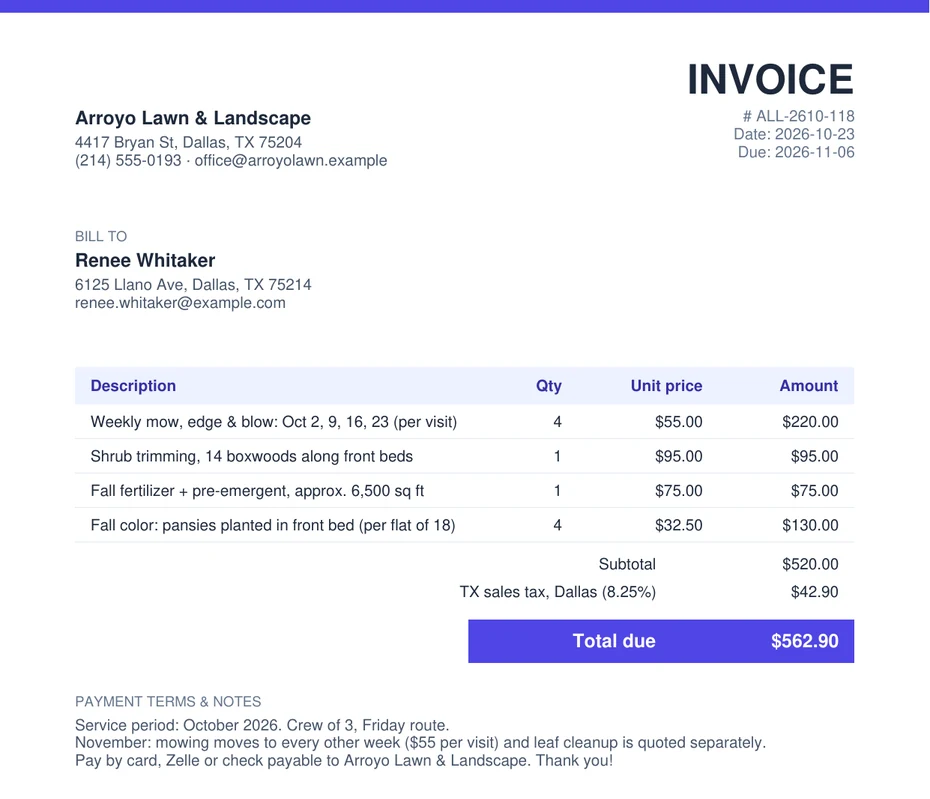
Your business name and phone number, the client's name and the property address you serviced, a unique invoice number, the service dates or period, and one line per job: mowing visits with the count in the Qty column, trimming, fertilizer or weed control with the lawn size, plants and mulch with quantities, and any cleanup or haul-off. Then the subtotal, sales tax if your state taxes the work, the total due, how to pay, and what changes next month.
Line items lawn care and landscaping crews actually bill
- Recurring mowing as a count of visits: one line with the dates, visits in Qty and the per-visit price in Unit price, e.g. "Weekly mow, edge & blow: Oct 2, 9, 16, 23" × 4 at $55. A skipped week shows up as a 3, so nobody has to ask.
- Trimming and pruning with a count: "14 boxwoods along front beds" or "2 crape myrtles, pruned" tells the client what the $95 bought.
- Treatments with the area: fertilizer, pre-emergent or weed control with the approximate square footage, since that is what the price is based on.
- Plants and materials with units: flats, gallons, cubic yards of mulch, pallets of sod.
- Cleanups and haul-off as one-off lines, with the number of bags or loads if you charge by volume.
- Design fees, hardscape and irrigation installs on their own lines. In Texas these follow different tax rules from mowing and planting (see below).
Sales tax on landscaping: Texas and New York
Texas. The Comptroller says landscapers and lawn care providers should collect state and local tax "on the total charge" for any work that maintains or improves lawns, yards, ornamental plants and trees. The taxable list includes planting, mowing, trimming and edging grass, pruning, fertilizing and watering plants, planting flower gardens and tree maintenance. Mowing highway or pipeline rights-of-way, trimming trees away from power lines, farm and forest work and mowing cemeteries are not taxable. Landscape designers' and architects' professional services are not taxable either. If you put nontaxable work on the same line as taxable work, the whole charge is presumed taxable when the taxable part is more than 5%, so list them separately. A self-employed person who does the work alone, with no employees or partners, and has $5,000 or less in receipts over the most recent four calendar quarters does not collect tax. Decks, retaining walls, fences, pools and sprinkler installs are construction, not landscaping, and follow the construction rules (Texas Comptroller publication 94-112, Landscaping and Lawn Care Services). The example above is a three-person crew, so it charges tax. Texas state tax is 6.25% and local jurisdictions can add up to 2%, for a maximum combined rate of 8.25% (Texas Sales and Use Tax). Dallas is at that 8.25%: 1% city plus 1% Dallas MTA (Comptroller city rate table). Check the rate for your client's address before you fill in the Tax % field.
New York. Landscapers count as contractors for sales tax. Maintenance is taxable on both materials and labor: mowing lawns, trimming hedges and trees, reseeding bare spots, snow removal, opening or closing sprinkler systems, and planting annuals. A capital improvement is not taxed when the customer gives you a completed Form ST-124, Certificate of Capital Improvement. Examples are planting or installing a new lawn, planting shrubs, trees or perennials, building retaining walls and installing permanent ponds. Removing a tree is taxable maintenance unless it is part of a capital improvement, for example when a new shrub is planted in its place (Tax Bulletin ST-505, Landscapers; see also Publication 862).
Other states set their own rules, and many do not tax lawn care. This is a summary of the published guidance, not tax advice, so confirm with your state or your accountant.
FAQ
Do lawn care and landscaping services charge sales tax?
In some states, yes. Texas taxes landscaping and lawn care on the total charge: mowing, edging, pruning, fertilizing, planting and tree care are all on the Comptroller's taxable list. A self-employed person with no employees or partners and $5,000 or less in receipts over the last four calendar quarters is exempt (Texas Comptroller publication 94-112). New York taxes maintenance such as mowing, hedge trimming and reseeding, but a capital improvement such as a new lawn, a retaining wall or planting trees and shrubs is not taxed when the customer gives you Form ST-124 (Tax Bulletin ST-505). Many states do not tax lawn care at all, so check your own state before you fill in the Tax % field.
How do I invoice monthly lawn maintenance?
Send one invoice at the end of each month and put the mowing visits on one line, with the dates in the description and the number of visits in Qty ("Weekly mow, edge & blow: Oct 2, 9, 16, 23", Qty 4 at $55). The client can see a rained-out week right away. Put one-off work such as trimming or fertilizer on its own lines, and say in the notes what changes next month, for example when mowing drops to every other week.
Should plants, mulch and sod go on separate lines?
Yes. Give each material a quantity and unit ("Hardwood mulch, 3 cu yd", "Pansies, per flat of 18"), so the client can check the count against what they see in the beds. In Texas the tax applies to the total charge for taxable landscaping, materials included. Keep design fees, construction work (retaining walls, fences, irrigation installs) and any nontaxable services on separate lines, because the Comptroller presumes the whole charge is taxable if those are lumped together and the taxable part is more than 5%.
How is a landscape installation invoice different from a maintenance invoice?
An install is usually a one-time project with a deposit, so bill the materials and the labor as separate lines and deduct the deposit (rename the Discount line to "Deposit received"). The tax can also differ. In New York, planting a new lawn, shrubs, trees or perennials and building a retaining wall are capital improvements, so you collect a signed Form ST-124 and don't charge sales tax, while mowing and trimming are taxable maintenance. In Texas, building decks, retaining walls, fences or pools and installing sprinkler systems are not landscaping at all and fall under the construction rules. Because InvoiceSnap applies one tax rate per invoice, put taxable and nontaxable work on separate invoices.
Is InvoiceSnap free?
Yes. You can fill in the invoice and download a watermarked preview PDF free with no signup. A clean PDF is $4 one-time for 7 days of unlimited invoices (USDC; card coming soon).
Is my data uploaded?
No. The PDF is generated in your browser; your client and pricing details are not sent to a server.
More invoice templates
Freelance invoice template (fill online → PDF) · Independent contractor invoice template · Hourly invoice template (hours worked) · Consulting invoice template · Invoice with a discount line · Invoice template for international clients · Photography invoice template · Cleaning invoice template · InvoiceSnap home