What should a painting invoice include?
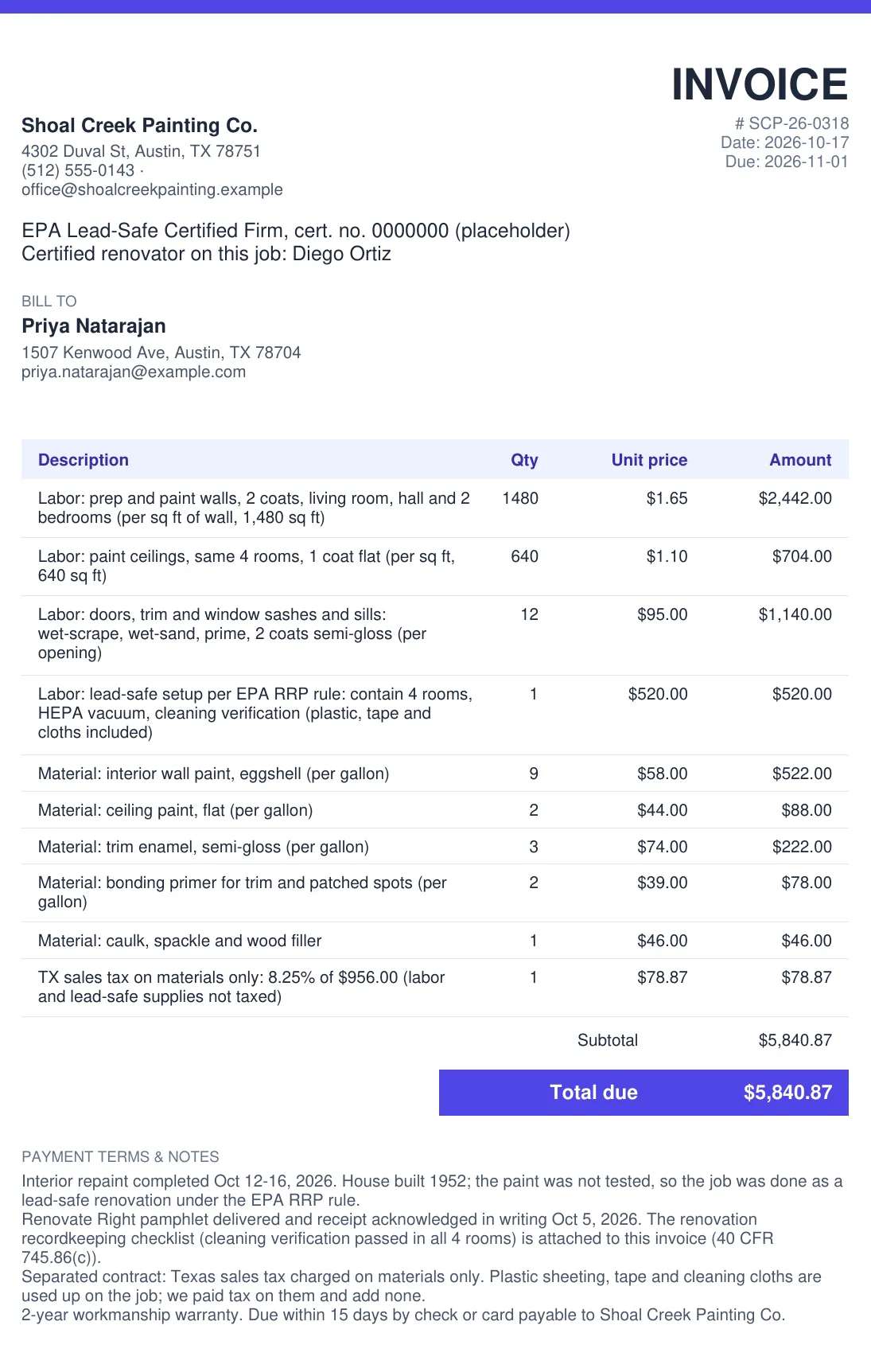
Your business name, address and phone number, the customer's name and the job address, a unique invoice number, and the dates the work was done. Then one line per charge: wall area and coats, ceilings, doors, trim and windows by the opening, any repair or prep work, and the paint by product, sheen and gallon. Finish with the subtotal, sales tax where it applies, the total due, your warranty and how to pay. On a house built before 1978, add your EPA (or state) lead-safe firm certification and say whether the paint was tested; federal rules require you to give the owner your lead-safe compliance information when you deliver the final invoice, or within 30 days of finishing if that comes first.
Line items painters actually bill
- Walls by area and coats: "Prep and paint walls, 2 coats, living room, hall and 2 bedrooms", with the measured square footage in Qty. Naming the rooms makes it easy to bill a room the customer added on the day as its own line.
- Ceilings on their own line, because they are often a different coat count, paint and rate.
- Doors, trim and windows by the opening, with the prep in the description (scrape, sand, prime, coats). Prep is where most of the time goes on old trim.
- Paint by product, sheen and gallon: wall eggshell, ceiling flat, trim semi-gloss, primer. A touch-up a year later is easier when the invoice says what went on the walls.
- Repairs and prep supplies such as caulk, spackle and wood filler, on one line.
- On a house built before 1978, a lead-safe setup line and your firm certification, and a note on the paperwork (see below).
Pre-1978 homes: the EPA lead rule and your invoice
Who it covers. EPA's Renovation, Repair and Painting (RRP) rule applies to renovations performed for compensation in target housing and child-occupied facilities (40 CFR 745.82). Target housing is housing built before 1978, except housing for the elderly or people with disabilities and 0-bedroom dwellings, unless a child under 6 lives or is expected to live there (40 CFR 745.103). Renovation includes "surface preparation activity (such as sanding, scraping, or other such activities that may generate paint dust)" (40 CFR 745.83). EPA lists painters among the trades covered and says firms, "even sole proprietorships", cannot advertise or perform covered work without firm certification (EPA, RRP Program: Contractors). EPA firm certifications are good for five years (EPA, RRP Program: Firm Certification).
What is exempt. Housing built in 1978 or later; components a certified inspector or risk assessor has determined are free of lead-based paint, or that a certified renovator has tested with an EPA-recognized test kit or paint chip samples (745.82(a)); and minor repair and maintenance that disturbs 6 square feet or less of painted surface per room inside or 20 square feet or less outside, with no window replacement, no demolition of painted surfaces and none of the prohibited practices. Jobs in the same room within 30 days count as one job for that limit (745.83). EPA notes that paint testing is not required, "but unless you have documentation that the paint is not lead-based, then the requirements of the RRP Rule apply." That is the situation in the example: a 1952 house, paint not tested, trim scraped and sanded, so the job was run as a renovation.
Before the job. No more than 60 days before starting work in a dwelling unit, the firm must give the owner EPA's Renovate Right pamphlet and either get a written acknowledgment of receipt or a certificate of mailing at least 7 days before the renovation. If the owner doesn't live there, an adult occupant gets the pamphlet too (40 CFR 745.84(a)). The acknowledgment can be a separate sheet or part of the written contract (745.84(d)).
With the final invoice. This is the part that touches billing directly. Section 745.86(c)(1) says: "When the final invoice for the renovation is delivered or within 30 days of the completion of the renovation, whichever is earlier, the renovation firm must provide information pertaining to compliance with this subpart" to the owner and, if different, an adult occupant. The information can be provided on EPA's "Sample Renovation Recordkeeping Checklist" or a similar form (745.86(c)(3)), and the firm keeps its records for 3 years after the renovation (745.86(a)) (40 CFR 745.86). The example's notes say the checklist is attached and record the pamphlet date.
Work practices that change the price. The rule requires signs, containment (inside: objects removed or covered, ducts closed and covered, windows and doors closed, doors covered with plastic, and floors covered with taped-down plastic 6 feet beyond the work surfaces), contained waste and a cleaning verification at the end. It prohibits open-flame burning, high-speed sanding or grinding without a shroud and HEPA vacuum attachment, and heat guns at 1,100 °F or more (745.85). That labor is real, so the example bills it as its own line instead of hiding it in the per-square-foot rate.
Which agency. EPA runs the program everywhere except the states and the tribe it has authorized to run their own: Alabama, Delaware, Georgia, Iowa, Kansas, Massachusetts, Mississippi, North Carolina, Oklahoma, Oregon, Rhode Island, Utah, Vermont, Washington and Wisconsin, plus the Minnesota Chippewa Tribe - Bois Forte, per EPA's firm certification page. Texas is not on the list, so the example uses EPA certification.
Texas: sales tax on painting jobs
Houses. The Texas Comptroller says labor to repair, remodel or restore residential real property (family dwellings, apartment complexes, nursing homes, condominiums and retirement homes, but not hotels or rentals of less than 30 days) is not taxable. On a lump-sum job you pay tax on supplies and materials when you buy them and do not charge the customer tax. On a separated contract you give suppliers a resale certificate and collect state and local tax on the materials charge, which must be at least what you paid; the construction labor charge is not taxable (Texas Comptroller publication 94-116, Real Property Repair and Remodeling).
Commercial buildings. The same publication says "Repair or remodeling includes reroofing and repainting. But if the repainting is maintenance (as defined in this bulletin), tax is not due on the repainting labor." Maintenance is scheduled, periodic work on property that is not broken, you need a contract or other documentation showing that it is scheduled and periodic, and the incorporated materials are still taxable.
Drop cloths, plastic and tape. The contractor rule defines consumable items as things used up on the job, with "nonreusable drop cloths" and "barricade tape" as examples. A contractor pays tax on them when it buys them and "may not collect tax from the customer on a charge for consumable items", except under a narrow title-transfer arrangement on separated contracts (34 TAC §3.291(a)(2) and (b)(2), official Texas Administrative Code). The rule also says separated invoices do not turn a lump-sum contract into a separated contract unless the contract requires separated invoices (§3.291(a)(8)).
So the example taxes the $956 of paint, primer and caulk and not the $4,806 of labor, which includes the lead-safe supplies. Texas state tax is 6.25% and local jurisdictions can add up to 2% (Texas Sales and Use Tax). Austin addresses in Travis County are at the 8.25% maximum: 1% city plus 1% Austin MTA (Comptroller city rate table). Check the rate for the job address before you bill.
Other states have their own sales-tax rules, and the fifteen authorized states run their own lead programs. This is a summary of the federal regulations, EPA guidance and Texas rules, not legal or tax advice, so confirm with EPA, your state program, the Comptroller or your accountant.
FAQ
Should painters bill by the square foot, by the room or by the hour?
Any of the three works on this template. By the square foot, put the measured wall or ceiling area in Qty and your rate per square foot in Unit price, as in the example (1,480 sq ft × $1.65 = $2,442.00). By the room or by the opening, put the count in Qty. By the hour, put hours in Qty. Whichever you use, name the rooms and the number of coats in the description, so the customer can check the invoice against your estimate. In Texas the split between labor and paint also decides the sales tax (see below).
Do painters need lead-safe certification for houses built before 1978?
Usually, yes. EPA's Renovation, Repair and Painting (RRP) rule covers renovations done for pay in housing built before 1978 and in child-occupied facilities, and its definition of renovation includes surface preparation such as sanding and scraping (40 CFR 745.82 and 745.83). EPA says firms, including sole proprietorships, cannot advertise or perform covered work without firm certification, and that painters are among the trades covered. The exceptions include housing built in 1978 or later, components a certified inspector, risk assessor or renovator has shown to be lead-free, and minor repair and maintenance that disturbs 6 square feet or less of painted surface per room inside or 20 square feet or less outside, as long as it involves no window replacement, no demolition of painted surfaces and none of the prohibited practices. Fifteen states run their own programs instead of EPA; Texas is not one of them.
What lead paperwork goes with a painting invoice?
Two pieces. Before the job: no more than 60 days before starting work in a pre-1978 home, give the owner EPA's Renovate Right pamphlet and either get a signed acknowledgment or a certificate of mailing at least 7 days before work starts (40 CFR 745.84(a)). The acknowledgment can be a separate sheet or part of your contract. After the job: when the final invoice is delivered, or within 30 days of finishing, whichever is earlier, give the owner (and an adult occupant, if the owner doesn't live there) the information showing how you complied, which can be EPA's Sample Renovation Recordkeeping Checklist or a similar form (40 CFR 745.86(c)). Keep the records for 3 years (745.86(a)). The example attaches the checklist to the invoice and says so in the notes.
Do painters charge sales tax in Texas?
On a house, not on the labor. The Texas Comptroller says labor to repair, remodel or restore residential real property is not taxable. On a lump-sum job (one price for everything) you pay tax on the paint when you buy it and do not charge the homeowner tax. On a separated contract (labor and materials priced separately) you buy the paint with a resale certificate and collect state and local tax on the materials charge, which must be at least what you paid. Commercial work is different: the Comptroller says repair or remodeling of nonresidential property includes repainting and is taxable on the total charge, but if the repainting is maintenance, meaning scheduled, periodic work on property that is not broken, tax is not due on the repainting labor (publication 94-116).
How do I charge sales tax on materials only in InvoiceSnap?
InvoiceSnap applies its Tax % field to the whole subtotal, so for a separated residential job leave Tax % at 0 and add the tax as its own line, as in the example: "TX sales tax on materials only: 8.25% of $956.00", Qty 1, Unit price $78.87. The materials are 9 gallons × $58 ($522) + 2 × $44 ($88) + 3 × $74 ($222) + 2 × $39 ($78) + $46 = $956, and 8.25% of that is exactly $78.87. With $4,806 of labor ($2,442 walls + $704 ceilings + $1,140 for 12 openings + $520 lead-safe setup), the total is $5,840.87. For a commercial repaint that is taxable on the total charge, put the rate in the Tax % field instead.
Can I charge sales tax on drop cloths, plastic and tape?
Not in the example's setup. The Comptroller's contractor rule calls nondurable items that are used up on the job, such as nonreusable drop cloths and barricade tape, consumable items. A contractor pays tax on them when buying them and may not collect tax from the customer on a charge for them (34 TAC §3.291(a)(2) and (b)(2)). The narrow exception is a separated contract where title passes to the customer before the contractor takes possession and the items are marked as the customer's. That is why the example folds the lead-safe plastic, tape and cleaning cloths into an untaxed labor line and taxes only the paint, primer and caulk that stay on the walls.
Does sending a separate labor and materials invoice make it a separated contract?
Not by itself. Under the same rule, a contract that states one price for materials and labor is a lump-sum contract, and separated invoices do not turn it into a separated contract unless the contract itself requires separated invoices (34 TAC §3.291(a)(8)). Price labor and materials separately in the estimate or contract the customer signs, then invoice the same way.
Is InvoiceSnap free?
Yes. You can fill in the invoice and download a watermarked preview PDF free with no signup. A clean PDF is $4 one-time for 7 days of unlimited invoices (USDC; card coming soon).
Is my data uploaded?
No. The PDF is generated in your browser; your client and pricing details are not sent to a server.
More invoice templates
Freelance invoice template (fill online → PDF) · Independent contractor invoice template · Hourly invoice template (hours worked) · Consulting invoice template · Invoice with a discount line · Invoice template for international clients · Photography invoice template · Cleaning invoice template · Landscaping & lawn care invoice template · Plumbing invoice template · Electrician invoice template · HVAC invoice template · Roofing invoice template · Handyman invoice template · InvoiceSnap home