What should a moving company invoice include?
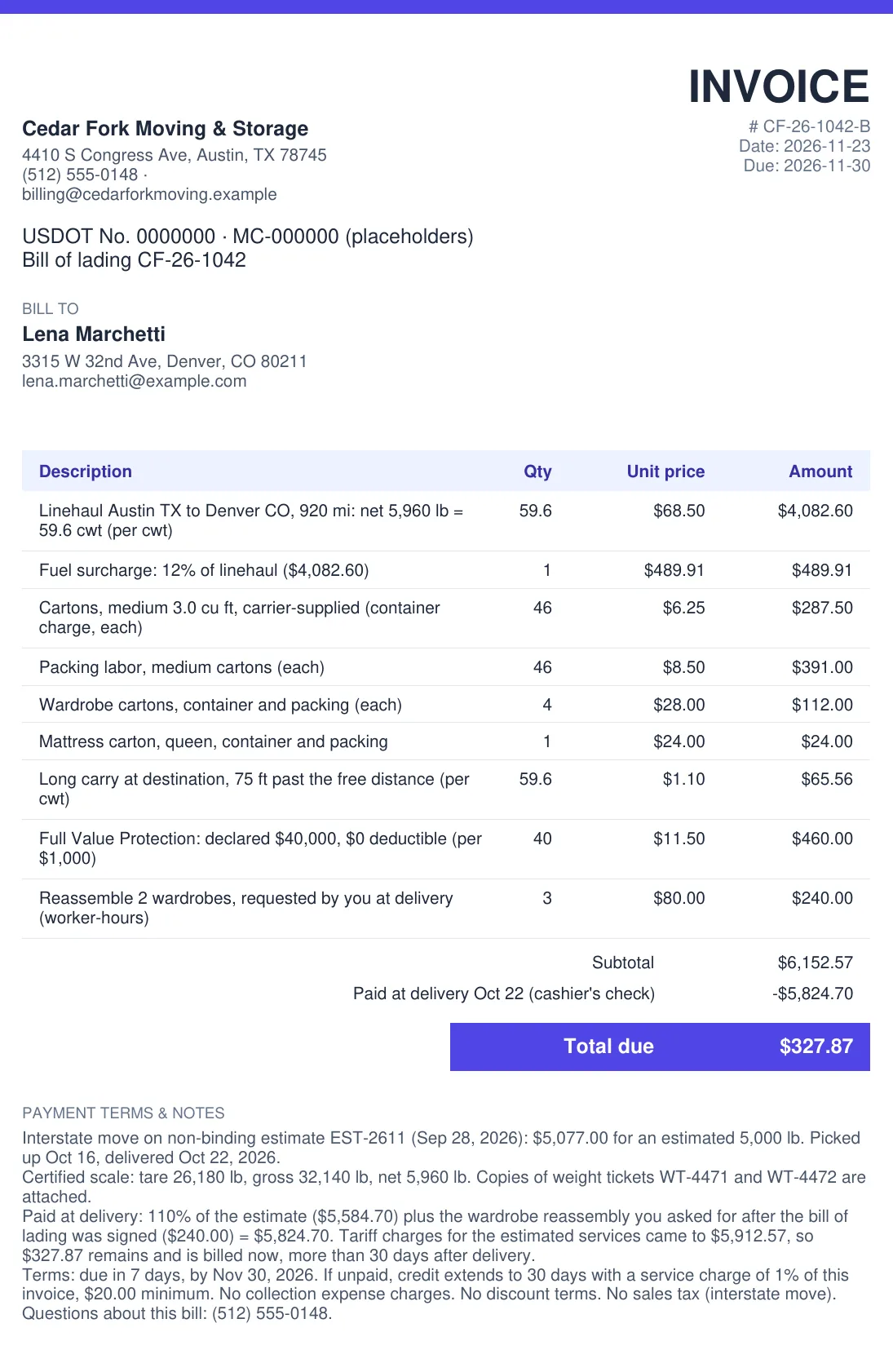
Every service you performed, the rate for each, and the total for each. The FMCSA booklet that interstate movers must give or link for their customers says: "Except in those instances where a shipment is moving on a binding estimate, the invoice must specifically identify each service performed, the rate or charge per service performed, and the total charges for each service. If this information is not on the invoice, do not accept or pay the invoice." Add your legal name and USDOT number, the bill of lading number, origin and destination, the estimate (binding or non-binding, and its amount), the weight with copies of the weight tickets, the valuation choice, what was paid at delivery, the balance, and the payment terms. The example: $6,152.57 in charges, $5,824.70 paid at delivery, $327.87 due.
Line items movers actually bill
- Linehaul by weight and distance, with the net weight in hundredweight: "net 5,960 lb = 59.6 cwt", 59.6 × $68.50. Local movers billing by the hour put crew-hours × rate here instead.
- Fuel surcharge as its own line with its percentage and base.
- Cartons and packing: the carton (container) charge and the packing labor, per carton, by size. Wardrobe and mattress cartons usually carry their own price.
- Accessorials: long carry, stairs, elevator, shuttle truck, appliance service, crating. Say where each happened (origin or destination).
- Valuation: Full Value Protection with the declared value and deductible, or released value at no charge.
- Anything the customer added after the bill of lading on its own line, because it is paid in full at delivery on top of the 110%.
- The weights, the estimate and what was already paid, then the balance and the terms.
How the example adds up
| Part of the invoice | Working | Amount |
|---|---|---|
| Net weight | 32,140 lb gross − 26,180 lb tare = 5,960 lb = 59.6 cwt | |
| Linehaul | 59.6 cwt × $68.50 | $4,082.60 |
| Fuel surcharge | 12% × $4,082.60 = $489.912 | $489.91 |
| Medium cartons | 46 × $6.25 | $287.50 |
| Packing labor | 46 × $8.50 | $391.00 |
| Wardrobe + mattress cartons | 4 × $28 + 1 × $24 | $136.00 |
| Long carry | 59.6 cwt × $1.10 | $65.56 |
| Full Value Protection | 40 × $11.50 per $1,000 declared | $460.00 |
| Estimated services at tariff | All of the above | $5,912.57 |
| Wardrobe reassembly | 3 worker-hours × $80, added at delivery | $240.00 |
| Subtotal | $5,912.57 + $240.00 | $6,152.57 |
| Paid at delivery | 110% × $5,077.00 = $5,584.70, plus $240.00 | −$5,824.70 |
| Total due | $6,152.57 − $5,824.70, by Nov 30, 2026 | $327.87 |
Checking the 110%. The estimate was $5,077.00 for 5,000 lb; the shipment weighed 5,960 lb, so the same services cost $5,912.57 at the tariff, about 116% of the estimate. At delivery the mover could ask for no more than $5,584.70 for those services, plus the full $240.00 for the reassembly Lena asked for at the door. The other $327.87 ($5,912.57 − $5,584.70) is this invoice. The rates are the example's, not a benchmark, and the USDOT and MC numbers are placeholders.
In InvoiceSnap. The delivery payment goes in the Discount field (Fixed, relabelled "Paid at delivery Oct 22 (cashier's check)"), Tax % stays at 0 because the move is interstate, and the bill of lading number sits in the License field so it prints under your name.
What federal rules put on an interstate moving invoice
An honest, itemized bill. "You must issue an honest, truthful invoice that includes all the information required by subpart A of part 373 of this chapter." (49 CFR §375.215.) That subpart's freight-bill list (§373.103(a)) includes the consignor and consignee, date of shipment, origin and destination, weight, "Exact rate(s) assessed.", "Total charges due, including the nature and amount of any charges for special service and the points at which such service was rendered." and "Address where remittance must be made or address of bill issuer's principal place of business."
Each service, its rate, its total. The booklet movers must give customers, "Your Rights and Responsibilities When You Move" (Appendix A to Part 375): "Except in those instances where a shipment is moving on a binding estimate, the invoice must specifically identify each service performed, the rate or charge per service performed, and the total charges for each service." That is why every line in the example has a quantity and a rate, not a lump sum.
Weight tickets. "All freight bills you present to an individual shipper must include true copies of all weight tickets obtained in the determination of the shipment weight in order to collect any shipment charges dependent upon the weight transported." (§375.519(d).) The example's notes give tare, gross and net and name both tickets.
Five notices. The booklet: "Your mover's invoice and accompanying written notices must state the following five items": penalties for late payment, the period of time for any credit extended, service or finance charges, collection expense charges, and any applicable discount terms. The example's Terms line states all five, including the two that are "none".
The 110% rule, step by step
On the estimate. A non-binding estimate "must clearly state that the shipper will not be required to pay more than 110 percent of the non-binding estimate at the time of delivery." (§375.405(b)(5).) If more goods turn up on moving day, the mover can reaffirm the estimate or write a new one before loading, and "Once you load a shipment, failure to execute a new non-binding estimate signifies you have reaffirmed the original non-binding estimate." (§375.405(b)(8).) The example's mover didn't write a new one, so $5,077.00 stayed the estimate.
At delivery. "If an individual shipper pays you up to 110 percent of the non-binding estimate on a collect-on-delivery shipment" the mover must hand over the goods (§375.407(a)), plus any service the customer asked for after the bill of lading: "You may require full payment at destination for these additional services" (§375.405(b)(10)). Impracticable-operation charges at delivery are capped: "You may not demand payment of charges for impracticable operations, as defined in your tariff, of more than 15 percent of all other charges due at delivery." (§375.407(d).) The example has none.
After delivery. The booklet: "The mover will bill you for any remaining charges after 30 days from delivery." The credit period on that bill "must be seven days (including Saturdays, Sundays, and Federal holidays)." and an unpaid bill rolls to 30 days with "a service charge to each individual shipper equal to one percent of the amount of the invoice, subject to a $20 minimum charge" (§375.807(b) and (c)(2)). On $327.87, 1% is $3.28, so the $20.00 minimum applies.
Where the rules don't line up
15 days or after 30 days? §375.807(a): "You must present an invoice within 15 days (excluding Saturdays, Sundays, and Federal holidays) of the date of delivery of a shipment at its destination." The booklet says the same for the main invoice ("On shipments paid upon delivery, your mover must present its invoice for all transportation charges on the date of delivery, or, at its discretion, within 15 days calculated from the date the shipment was delivered at your destination.") but also says "Bills for additional charges based on the weight of the shipment will be presented after 30 days from delivery". Neither text says how the two fit for a weight-based balance like the example's. The example does both: the full itemized freight bill with the weight tickets at delivery on Oct 22, and this balance bill on Nov 23, day 32. That is our reading, not a ruling; check your tariff and ask the FMCSA if it matters to you.
Texas: is moving taxable?
Transportation and packing: no. A 1993 Comptroller letter on STAR (9307041L) marks a mover's charges one by one: transportation by weight and miles or by the hour, interstate "Exempt", intrastate "NT"; packing and unpacking nontaxable; disassembly and reconnecting appliances for the move nontaxable. Storage: "Temporary or long term storage of motor vehicles or furs is taxable. Temporary or long term storage of other items is not taxed." That matches the statute's list of taxable services, which includes "motor vehicle parking and storage services" and does not list moving or transportation (Tax Code §151.0101).
Boxes: the two letters differ. The 1993 letter marks carrier-supplied boxes on an in-state move taxable, and its footnote says "If the moving company actually sells moving boxes, etc., to a customer, the moving company must collect tax from that customer on the sales price of these items." A 2000 letter (200005335L) says "The sale of a box without any moving service is taxable" but "The charge to a client for moving boxes used by the client or moving company to pack the goods being moved is part of the price/cost of the nontaxable moving service." For an interstate move like the example, the 1993 letter marks boxes "Exempt", so there is no tax line. For an in-state move where you charge for cartons, the letters point different ways; ask the Comptroller. Both letters are answers to one business: "This opinion is based upon the facts presented."
What we did not check
- Moving sales tax in any state other than Texas.
- State rules for moves within one state, including any state licensing, estimate or invoice requirements.
- The STB's current released-rates order; the booklet's 60 cents per pound may have been adjusted.
- Typical linehaul, packing or valuation rates; the example's are made up for the arithmetic.
- Storage-in-transit billing, guaranteed-delivery penalties, claims and arbitration.
This is a summary of 49 CFR Parts 373 and 375 (eCFR, current as of October 22, 2026), the FMCSA booklet in Appendix A to Part 375, two Texas Comptroller letters on STAR and Texas Tax Code §151.0101 as read on October 24, 2026, not legal or tax advice. Check with the FMCSA, the Texas Comptroller or your attorney or accountant.
Hauling freight rather than household goods? The trucking invoice template covers the general freight-bill rules: a 7-day billing deadline, 15-day credit, detention and lumpers.
Hauling things to the dump instead of a new home? The junk removal invoice template covers how Texas, Pennsylvania, Florida and Ohio tax junk removal.
FAQ
How do I write a moving invoice?
Start from the bill of lading and the estimate. Put the net weight in hundredweight (cwt) in Qty and your tariff rate in Unit price for the linehaul, then one line per accessorial: fuel, cartons, packing, long carry, stairs, shuttle, valuation. Put a service the customer asked for after the bill of lading was signed on its own line, because it is handled separately at delivery. Enter what the customer paid at delivery in the Discount field, set it to Fixed and relabel it "Paid at delivery". Note the weights and attach the weight tickets. In InvoiceSnap the totals update as you type and the free preview PDF shows the finished invoice.
What is the 110 percent rule for movers?
On an interstate move with a non-binding estimate, the mover must hand over your goods if you pay 110% of the estimate at delivery, plus any service you asked for after the bill of lading and up to 15% for impracticable operations. 49 CFR §375.405(b)(5): "The estimate must clearly state that the shipper will not be required to pay more than 110 percent of the non-binding estimate at the time of delivery." It does not cancel the rest of the bill. The FMCSA booklet: "This does not excuse you from paying all the charges due on your shipment. The mover will bill you for any remaining charges after 30 days from delivery."
What is the difference between a binding and a non-binding moving estimate?
A binding estimate "guarantees the total cost of the move based upon the quantities and services shown on your estimate" (49 CFR §375.401(b)(1)). A non-binding estimate is the mover's best guess: "A non-binding estimate is not binding on you. You will base the final charges upon the actual weight of the individual shipper's shipment and the tariff provisions in effect." (§375.401(b)(2)). Movers may charge for one and not the other: "You may impose a charge for providing a written binding estimate." but "You may not impose a charge for providing a non-binding estimate."
Can movers charge more than the estimate?
On a non-binding estimate, yes, but not all at once. At delivery the most they can demand is 110% of the estimate plus services you added after the bill of lading and capped impracticable-operation charges; the rest is billed later. On a binding estimate the amount at delivery is the estimate itself plus those same two extras (§375.703). The example's tariff charges came to $5,912.57 against a $5,077.00 estimate; Lena paid $5,584.70 (110%) plus $240.00 for the service she added, and got this $327.87 bill afterwards.
When does a mover have to send the final invoice?
49 CFR §375.807(a): "You must present an invoice within 15 days (excluding Saturdays, Sundays, and Federal holidays) of the date of delivery of a shipment at its destination." The FMCSA booklet also says "Bills for additional charges based on the weight of the shipment will be presented after 30 days from delivery". Those two time limits point in different directions for a weight-based balance like the example's; see "Where the rules don't line up" above. The example hands over the full freight bill at delivery and sends this balance bill on day 32.
What payment terms can a mover put on the invoice?
For balance-due invoices and shipments on credit, the credit period "must be seven days (including Saturdays, Sundays, and Federal holidays)." If the customer hasn't paid by then, the mover's tariff must extend it to 30 days, and "You will assess a service charge to each individual shipper equal to one percent of the amount of the invoice, subject to a $20 minimum charge, for the extension of the credit period." (49 CFR §375.807.) The booklet adds that the invoice and its notices must state penalties for late payment, the credit period, service or finance charges, collection expense charges and any discount terms; the example's notes cover all five.
What happens if I can't pay the mover at delivery?
The mover can keep the goods in storage. The FMCSA booklet: "If you are unable to pay 110 percent of the charges on a non-binding estimate at delivery, your mover may place your shipment in storage at your expense." But a mover that refuses to deliver after you pay 110% (non-binding) or 100% (binding), plus the allowed extras, is breaking the rule: "If your mover does not relinquish possession, the mover is holding your shipment hostage in violation of Federal law."
Is a bill of lading the same as a moving invoice?
Not quite, but movers often combine them. The FMCSA booklet: "It is customary for most movers to use a copy of the bill of lading as the invoice." The bill of lading is the contract and receipt, signed before loading and listing 17 required items (49 CFR §375.505(b)), including "The maximum amount you will demand at the time of delivery to obtain possession of the shipment, when you transport under a collect-on-delivery basis." The invoice is the bill. Put the bill of lading number on the invoice, as the example does in the License field.
Do movers have to include weight tickets with the invoice?
Yes, when the charges depend on weight. 49 CFR §375.519(d): "All freight bills you present to an individual shipper must include true copies of all weight tickets obtained in the determination of the shipment weight in order to collect any shipment charges dependent upon the weight transported." Each ticket must show the scale's name and location, the date, which entry is tare, gross or net, the vehicle, the shipper's last name and the bill of lading or registration number (§375.519(a)).
How does Full Value Protection show up on a moving invoice?
As its own line, with the declared value and deductible. The FMCSA booklet: "The minimum valuation level for determining the cost of Full Value Protection of your shipment is $6.00 per pound times the weight of your shipment." For the example's 5,960 lb that is $35,760, so the $40,000 declared value is above the minimum. The free alternative is released value: "Under this option, the mover assumes liability for no more than 60 cents per pound, per article." The regulation also says "The released rates may be increased annually by the motor carrier based on the U.S. Department of Commerce's Cost of Living Adjustment." We did not look up the current released rate, so check the STB's latest order before quoting a number.
Are moving services taxable in Texas?
Mostly not, going by two Comptroller letters on STAR. A 1993 letter marks interstate transportation charges "Exempt" and intrastate ones "NT" (nontaxable), packing and unpacking nontaxable, and storage of household goods untaxed, but "Temporary or long term storage of motor vehicles or furs is taxable." A 2000 letter: "Moving furniture from one location to another is not a taxable service." They disagree on boxes for in-state moves (see the Texas section above). Both are letters about one company's facts: "This opinion is based upon the facts presented." We did not check Washington, New York, Pennsylvania, Florida, New Jersey, Wisconsin, Ohio or Connecticut, which people also search for.
Do these federal rules apply to local moves?
No. Part 375 says: "You are subject to this part only when you transport household goods for individual shippers by motor vehicle in interstate commerce." Even some moves across a state line are outside it; the FMCSA booklet: "Moves that cross state lines within these zones are exempt from FMCSA's commercial jurisdiction and, therefore, the moves are not subject to FMCSA household goods regulations." (commercial zones around a city). Moves within one state follow that state's rules, which we did not check for this page.
Should a tip for the movers go on the invoice?
Part 375 and the FMCSA booklet don't mention tipping movers (we searched both), so they set no rule on it. A tip isn't a tariff charge, so leave it off the list of charges. If a customer adds one, record it separately so it isn't mistaken for part of the 110% payment.
Is InvoiceSnap free?
Yes. You can fill in the invoice and download a watermarked preview PDF free with no signup. A clean PDF is $4 one-time for 7 days of unlimited invoices (USDC; card coming soon).
Is my data uploaded?
No. The PDF is generated in your browser; your client and pricing details are not sent to a server.
More invoice templates
Freelance invoice template (fill online → PDF) · Independent contractor invoice template · Hourly invoice template (hours worked) · Consulting invoice template · Invoice with a discount line · Invoice template for international clients · Photography invoice template · Cleaning invoice template · Landscaping & lawn care invoice template · Plumbing invoice template · Electrician invoice template · HVAC invoice template · Roofing invoice template · Painting invoice template · Handyman invoice template · Deposit invoice template · Videographer invoice template · DJ invoice template · Tutoring invoice template · Lawn care invoice template · Late fee invoice template · Auto repair invoice template · Catering invoice template · Trucking invoice template · Web design invoice template · Translation invoice template · Pest control invoice template · Graphic design invoice template · Snow removal invoice template · Pool service invoice template · Pressure washing invoice template · Window cleaning invoice template · Junk removal invoice template · Carpet cleaning invoice template · Dog grooming invoice template · Pet sitting invoice template · InvoiceSnap home