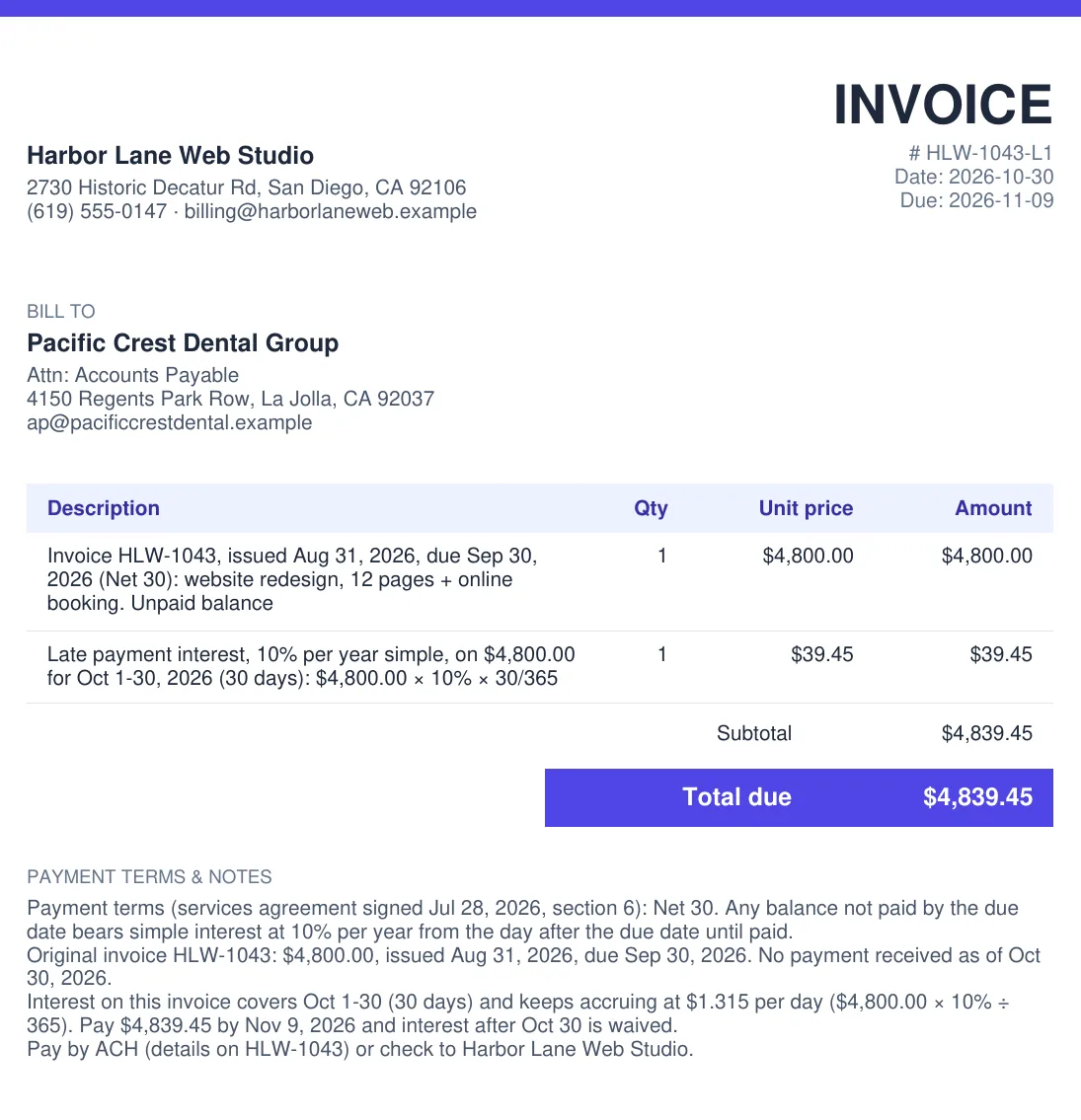
What should a late fee invoice include?
The original invoice number with its issue date, due date and unpaid amount; the late fee or interest as its own line that shows how it was worked out (rate, balance, days); the payment terms the charge comes from and when the client agreed to them; and a new due date. The example above: $4,800.00 unpaid since Sep 30, interest at 10% a year for Oct 1-30, $4,800.00 × 10% × 30/365 = $39.45, total $4,839.45 due Nov 9.
How the example adds up
| Part of the invoice | Working | Amount |
|---|---|---|
| Unpaid original | HLW-1043, due Sep 30, 2026 | $4,800.00 |
| Days late | Oct 1 to Oct 30 | 30 days |
| Interest | $4,800.00 × 10% × 30 ÷ 365 | $39.45 |
| Total due | Nov 9, 2026 | $4,839.45 |
After Oct 30 interest keeps running at $4,800.00 × 10% ÷ 365 = $1.315 a day. The notes offer to waive that if the client pays $4,839.45 by Nov 9, which keeps the number on the invoice final. If you'd rather reward early payment than penalise late payment, see the invoice with discount page; taking a deposit up front (deposit invoice template) shrinks what can go unpaid.
The same invoice under each rule
| Situation | Rule | Interest for Oct 1-30 |
|---|---|---|
| California, 10% agreed in writing | Civil Code § 3289(a) | $39.45 |
| California, no rate agreed | § 3289(b), 10% after breach | $39.45 |
| California, no rate agreed (conflict) | Const. art. XV, 7% on accounts after demand | $27.62 |
| Texas, 10% agreed | Finance Code § 302.001(b) maximum | $39.45 |
| Texas, no rate agreed | § 302.002, 6% from the 30th day after due | $0.00 (starts Oct 30, then $0.789 a day) |
Late fee wording you can copy
- Interest, in the contract and on every invoice: "Net 30. Any balance not paid by the due date bears simple interest at 10% per year from the day after the due date until paid."
- Flat fee instead: "A late fee of $40 applies to any balance unpaid 15 days after the due date." One fee, stated once, not stacked every month.
- On the late invoice: the original invoice number and due date on the first line, the calculation on the second, and where the terms come from: "Payment terms (services agreement signed Jul 28, 2026, section 6)".
- A way out: "Pay $4,839.45 by Nov 9, 2026 and interest after Oct 30 is waived." Clients pay a fixed number faster than a moving one.
The 10%, $40 and 15 days are the example's terms, not legal rules. Check them against your state before you use them.
California: what the code says
Agreed interest survives the missed due date. "Any legal rate of interest stipulated by a contract remains chargeable after a breach thereof, as before, until the contract is superseded by a verdict or other new obligation." No agreed rate: "If a contract entered into after January 1, 1986, does not stipulate a legal rate of interest, the obligation shall bear interest at a rate of 10 percent per annum after a breach." (Civil Code § 3289.) A fixed invoice amount fits § 3287(a): a person "who is entitled to recover damages certain, or capable of being made certain by calculation, and the right to recover which is vested in the person upon a particular day, is entitled also to recover interest thereon from that day" (Civil Code § 3287).
The constitution's usury limits. Article XV opens: "The rate of interest upon the loan or forbearance of any money, goods, or things in action, or on accounts after demand, shall be 7 percent per annum but it shall be competent for the parties to any loan or forbearance of any money, goods or things in action to contract in writing for a rate of interest". For personal, family or household use the written rate can go up to 10 percent per annum; for other uses "at a rate not exceeding the higher of (a) 10 percent per annum or (b) 5 percent per annum plus the rate prevailing on the 25th day of the month preceding" the contract, as set by the Federal Reserve Bank of San Francisco. And fees count: "No person, association, copartnership or corporation shall by charging any fee, bonus, commission, discount or other compensation receive from a borrower more than the interest authorized by this section upon any loan or forbearance of any money, goods or things in action." (Cal. Const. art. XV, § 1.) Conflict: the 7% "on accounts after demand" and § 3289(b)'s 10% "after a breach" both read on an unpaid invoice with no agreed rate. We didn't research which one a court would apply, or whether an overdue invoice is a "forbearance" at all, so the example uses a 10% rate agreed in writing, within every figure above.
Flat late fees. Between businesses, "a provision in a contract liquidating the damages for the breach of the contract is valid unless the party seeking to invalidate the provision establishes that the provision was unreasonable under the circumstances existing at the time the contract was made." For consumer contracts, § 1671(d) makes such a provision void unless the actual damage would be "impracticable or extremely difficult to fix" (Civil Code § 1671). Reading a flat late fee as this kind of clause is ours; the section doesn't say "late fee".
Texas: what the Finance Code says
The cap. "A creditor may contract for, charge, and receive from an obligor interest or time price differential." and "The maximum rate or amount of interest is 10 percent a year except as otherwise provided by law. A greater rate of interest than 10 percent a year is usurious unless otherwise provided by law." (Finance Code § 302.001.) Interest is "compensation for the use, forbearance, or detention of money." (§ 301.002(a)(4).)
No agreed rate. "If a creditor has not agreed with an obligor to charge the obligor any interest, the creditor may charge and receive from the obligor legal interest at the rate of six percent a year on the principal amount of the credit extended beginning on the 30th day after the date on which the amount is due." Fees turned into a rate: "If an obligor has agreed to pay to a creditor any compensation that constitutes interest, the obligor is considered to have agreed on the rate produced by the amount of that interest, regardless of whether that rate is stated in the agreement." (§ 302.002.) If a flat fee counts as interest, the size of the balance matters: by our arithmetic $50 on a $300 invoice paid 30 days late is 50 ÷ 300 × 365 ÷ 30 = about 203% a year, while $50 on the example's $4,800.00 is about 12.7%.
Not for invoices. § 302.001(d) allows a delinquency charge of "the greater of five percent of the amount of the payment or $7.50", but only for "a loan providing for a rate of interest that is 10 percent a year or less". It is about loans, so we don't cite it as permission for a 5% invoice late fee.
What we did not check
- Texas laws that allow more than 10% (the "except as otherwise provided by law" in § 302.001(b)), including Finance Code chapter 303.
- Whether a flat late fee on a service invoice counts as interest in Texas, or as a "forbearance" under California's Article XV.
- The current Federal Reserve Bank of San Francisco rate, so we give no figure for California's business ceiling above 10%.
- Court decisions on any of these sections; this page quotes the statutes only.
- Whether a late charge is subject to sales tax, government prompt-payment laws, landlord or credit card late fees, and every state other than California and Texas.
This is a summary of the California Civil Code and Constitution and the Texas Finance Code as read on October 24, 2026, not legal or tax advice. Ask a lawyer in your state before you rely on a rate or fee.
Interstate movers have their own federal late-payment terms: a 7-day credit period, then 1% with a $20 minimum. See the moving invoice template.
Trucking has its own federal default: freight bills are due 15 days after presentation unless a tariff sets up to 30. See the trucking invoice template.
FAQ
How do I add a late fee to an invoice?
Make a new invoice (or a reissue with a suffix, like HLW-1043-L1) whose first line is the unpaid original: its number, dates and balance. Add the late charge as a second line, Qty 1, with the calculation written in the description, so the client can check it without asking. Quote your payment terms in the notes and say when they were agreed. In InvoiceSnap the total updates as you type and the free preview PDF shows the finished invoice. The example has no sales tax line; whether your state taxes the original work or a late charge is a separate question we did not check for this page.
What is good late fee wording for an invoice?
For interest: "Net 30. Any balance not paid by the due date bears simple interest at 10% per year from the day after the due date until paid." For a flat fee: "A late fee of $40 applies to any balance unpaid 15 days after the due date." On the late invoice itself, point back to the agreement: "Payment terms (services agreement signed Jul 28, 2026, section 6)". These are our example terms, not legal minimums or maximums. Put the same words in the contract the client signs, not only on the invoice: California's rule is about a rate "stipulated by a contract", and Texas's default rate applies when the creditor "has not agreed with an obligor to charge the obligor any interest".
How much can I charge for a late fee on an invoice?
There is no single US number. For interest, Texas says "The maximum rate or amount of interest is 10 percent a year except as otherwise provided by law." California's constitution allows a written rate on a "loan or forbearance" for business purposes "at a rate not exceeding the higher of (a) 10 percent per annum or (b) 5 percent per annum plus" a Federal Reserve Bank of San Francisco rate, which we did not look up. Whether an overdue service invoice counts as a forbearance is a legal question we did not research. For flat fees in California, a business-to-business late fee clause is tested under Civil Code § 1671(b). We did not check other states.
Are late fees on invoices legal in California?
Interest is, if the contract sets it: "Any legal rate of interest stipulated by a contract remains chargeable after a breach thereof, as before, until the contract is superseded by a verdict or other new obligation." (Civil Code § 3289(a)). A flat late fee in a contract between businesses is a clause fixing damages in advance, and § 1671(b) says such a provision "is valid unless the party seeking to invalidate the provision establishes that the provision was unreasonable under the circumstances existing at the time the contract was made." Consumers are treated differently (see below). Treating a flat late fee as a § 1671 liquidated damages clause is our reading; the section does not use the words "late fee".
What interest can I charge on an unpaid invoice in California if the contract says nothing?
Civil Code § 3289(b): "If a contract entered into after January 1, 1986, does not stipulate a legal rate of interest, the obligation shall bear interest at a rate of 10 percent per annum after a breach." On the example that is the same $39.45 for 30 days. But the California Constitution, Article XV, opens with "The rate of interest upon the loan or forbearance of any money, goods, or things in action, or on accounts after demand, shall be 7 percent per annum", and 7% for the same 30 days is $27.62. We did not research how courts reconcile the two. The example sidesteps the question with a 10% rate agreed in writing.
Are late fees on invoices legal in Texas?
Interest is: "A creditor may contract for, charge, and receive from an obligor interest or time price differential." The cap: "The maximum rate or amount of interest is 10 percent a year except as otherwise provided by law. A greater rate of interest than 10 percent a year is usurious unless otherwise provided by law." (Finance Code § 302.001). Texas defines interest as "compensation for the use, forbearance, or detention of money" (§ 301.002(a)(4)). We did not check whether a flat late fee on a service invoice counts as interest, or which other laws allow more than 10%.
What is the legal interest rate in Texas if no rate was agreed?
Six percent a year, and it starts late: "If a creditor has not agreed with an obligor to charge the obligor any interest, the creditor may charge and receive from the obligor legal interest at the rate of six percent a year on the principal amount of the credit extended beginning on the 30th day after the date on which the amount is due." (Finance Code § 302.002). For the example's $4,800.00 due Sep 30, that starts Oct 30 and runs at $0.789 a day ($4,800.00 × 6% ÷ 365). The Oct 30 invoice above would carry no statutory interest yet.
Is a 1.5% monthly late fee legal?
1.5% a month is 18% a year. That is above the 10% a year in Texas Finance Code § 302.001(b) and above the flat 10% branches of California's Article XV. Both leave room for more: Texas "except as otherwise provided by law", and California's business branch through the San Francisco Fed rate plus 5%. We did not verify either route for this page, so don't copy 1.5% a month onto a Texas or California invoice because you've seen it elsewhere.
How do I calculate interest on an overdue invoice?
Simple interest is balance × annual rate × days late ÷ 365. Count from the day after the due date. The example: $4,800.00 × 10% × 30 ÷ 365 = $39.45 for Oct 1-30, or $1.315 a day. Write the calculation into the line description so the client can check it, and recalculate on each reminder instead of charging interest on last month's interest unless your contract says so.
Can I add a late fee if it wasn't in my payment terms?
For interest, the two states we checked set a rate when nothing was agreed: Texas 6% a year from the 30th day after the due date (§ 302.002), California 10% a year after a breach (§ 3289(b), with the 7% conflict above). For a flat fee, the sections we read only speak to fees the contract sets, so we would not add a surprise flat fee to an invoice. Put it in your terms for the next job.
Do the rules differ when the client is a consumer?
In California, yes. § 1671(c) covers "A party to a contract for the retail purchase, or rental, by such party of personal property or services, primarily for the party’s personal, family, or household purposes", and for those contracts a damages clause "is void except that the parties to such a contract may agree therein upon an amount which shall be presumed to be the amount of damage sustained by a breach thereof, when, from the nature of the case, it would be impracticable or extremely difficult to fix the actual damage." Article XV also has a separate 10% branch for personal, family or household use. The example client is a dental practice, a business.
What about other states, the UK or Australia?
We only read California and Texas law for this page. Searches for UK, Australian, Canadian and Washington state late fee rules are common, but we did not check them, so look up your own state or country before you add interest or a fee.
Is InvoiceSnap free?
Yes. You can fill in the invoice and download a watermarked preview PDF free with no signup. A clean PDF is $4 one-time for 7 days of unlimited invoices (USDC; card coming soon).
Is my data uploaded?
No. The PDF is generated in your browser; your client and pricing details are not sent to a server.
More invoice templates
Freelance invoice template (fill online → PDF) · Independent contractor invoice template · Hourly invoice template (hours worked) · Consulting invoice template · Invoice with a discount line · Invoice template for international clients · Photography invoice template · Cleaning invoice template · Landscaping & lawn care invoice template · Plumbing invoice template · Electrician invoice template · HVAC invoice template · Roofing invoice template · Painting invoice template · Handyman invoice template · Deposit invoice template · Videographer invoice template · DJ invoice template · Tutoring invoice template · Lawn care invoice template · Auto repair invoice template · Catering invoice template · Moving invoice template · Trucking invoice template · Web design invoice template · Translation invoice template · Pest control invoice template · Graphic design invoice template · Snow removal invoice template · Pool service invoice template · Pressure washing invoice template · Window cleaning invoice template · Junk removal invoice template · Carpet cleaning invoice template · Dog grooming invoice template · Pet sitting invoice template · InvoiceSnap home